Blog

3 High Performing Cryptocurrencies To Look Out For in 2020 Q4

The crypto market is in a spring right now, and here are three high-performing tokens to watch.

Photo by Worldspectrum on Pexels.com

So far, 2020 has been a year of ups and downs in the financial market, especially since the advent of the coronavirus, with stocks jumping all over the place. Cryptos have also had their fair share and are in no way left out. Regardless, the financial market ecosystem has continued to seek out alternative liquidity investment plans and are rapidly turning to high performing cryptos and stocks.

In this guide, we’ll examine three (3) high performing cryptocurrencies, their market value and activity, historical performance, and what to expect in the remainder of 2020. Without much ado, let’s get started.

Read Also: 2020 Has Been The Year of DeFi. Here’s How It Has Given Cryptocurrencies A New Lease of Life

Cosmos

Cosmos (ATOM) is simply a double-layer network that comprises of a lot of independent, yet interoperable blockchains referred to “Zones” which operate based on the Byzantine Fault Tolerance (BFT) consensus algorithm. It facilitates the exchange of assets, tokens and data between blockchains.

  • Historical Performance

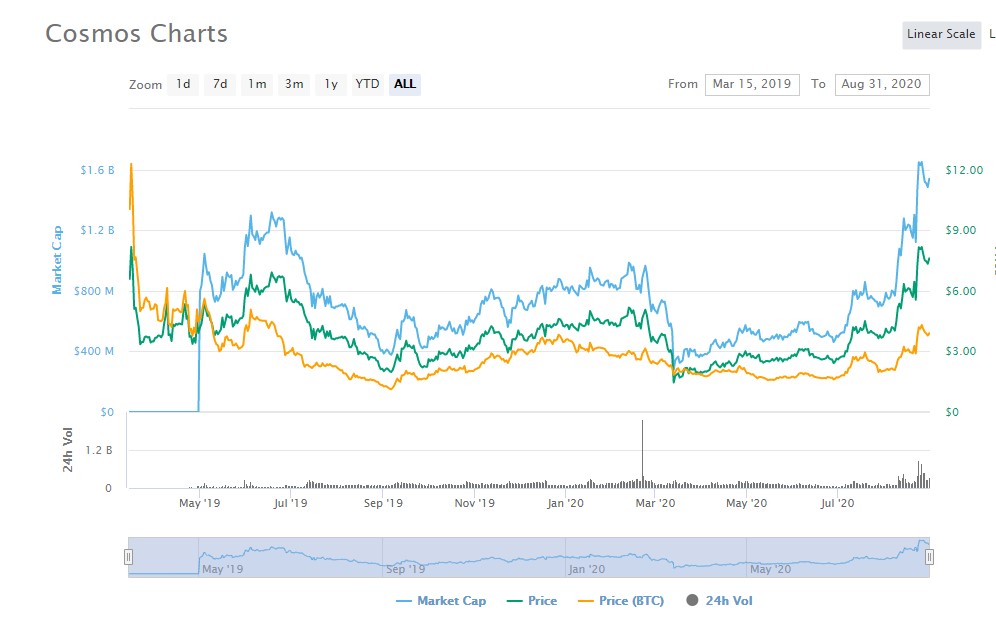
At the start of 2020, Cosmos had a market cap of $802.5 million and an average market price of $4.3. At the time of writing (August 31 2020), it’s now ranked 19th with a market cap of about $1.18 billion, a market price of $5.7, and a 24-hour trading volume of about $321 million. That’s a 47% growth in market cap and a 32.6% increase in market price over 8 months.
  • Core Area of Usefulness

Cosmos partners with OmiseGo, IRIS, Loom Network, FOAM, Theta Toe, etc. to provide solutions to blockchain scalability, sovereignty and complexity.


  • What to Expect

Cosmos has an average market cap of about $1.2 billion, and a surge is expected in the nearest future. Based on trends, crypto enthusiasts can expect Cosmos attain a market price of $10 by December 2020.                                                                                                                                                                                                                                                                                          

VeChain

VeChain is a blockchain-based crypto platform specifically designed to enhance business models and supply chain management with the aid of DLT. It aims to champion a distributed and trusted business ecosystem that ensures greater transparency in the flow of information, an ultra-swift transfer of value and efficient business collaborations. This project has numerous practical examples and is highly appreciated and recognised by Deloitte, BMW, PICC, PwC, H&M and lots more.

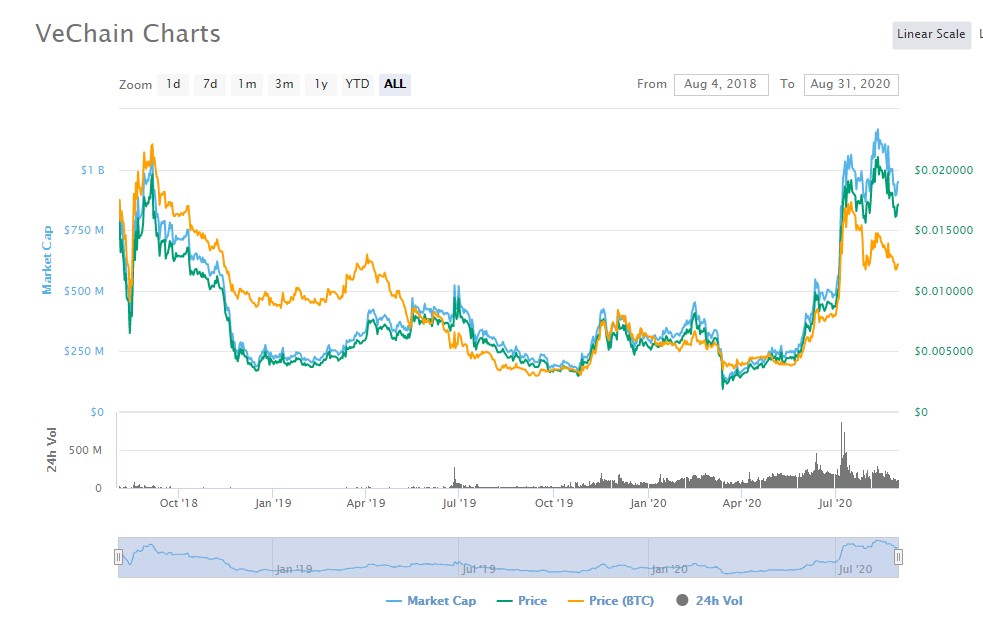
At the turn of the year 2020, VeChain was ranked 30th with a market cap of about $332.4 million and traded at $0.005643. Fast forward to today, it ranks 21st with a market cap of over $1.1 billion, and trading at an average $0.018553. That’s a bullish 258% growth in market cap and 228% surge in market price.
  • Core Area of Usefulness
  • Automobile data tamper-proof – Renault and BMW are currently partnering with VeChain. Data such as driver’s habit, repair history, registration, and insurance are made immutable.
  • Product Anti-duplication: this is executed with the aid of smart chips which ensures that products are not adulterated. Certain luxury brands have already signed up for this.
  • Cold-chain logistics via IoT sensors that automatically interface with the blockchain.
  • Carbon Credits: carbon emission tracking and rewards schemes for friends of the earth.
  • Provide solutions to the traceability of digitalized clinical trials.
  • What to Expect

The surge in the market activity and demand for VeChain is driven by its integration of IoT into supply chain management models. According to cryptoground, VeChain is expected to attain $2.58 by December 2020, although a little unrealistic.

To attain the $2 mark, VeChain would have to match Bitcoin’s market capitalization – that’s a difficult one. However, a more realistic prediction would peg VeChain at about $1 by the end of the year.

Chainlink 

Just like the two cryptos mentioned earlier, Chainlink is also doing exploits, and it has achieved new market prices multiple times already in 2020 – its token is LINK.  A Chainlink solution, Oracles, make it possible to aggregate real-world data, payments and events into the blockchain as smart contracts. Plus, this project finds application on DeFi platforms and is gradually making waves in the pharma space.

  • Historical Performance

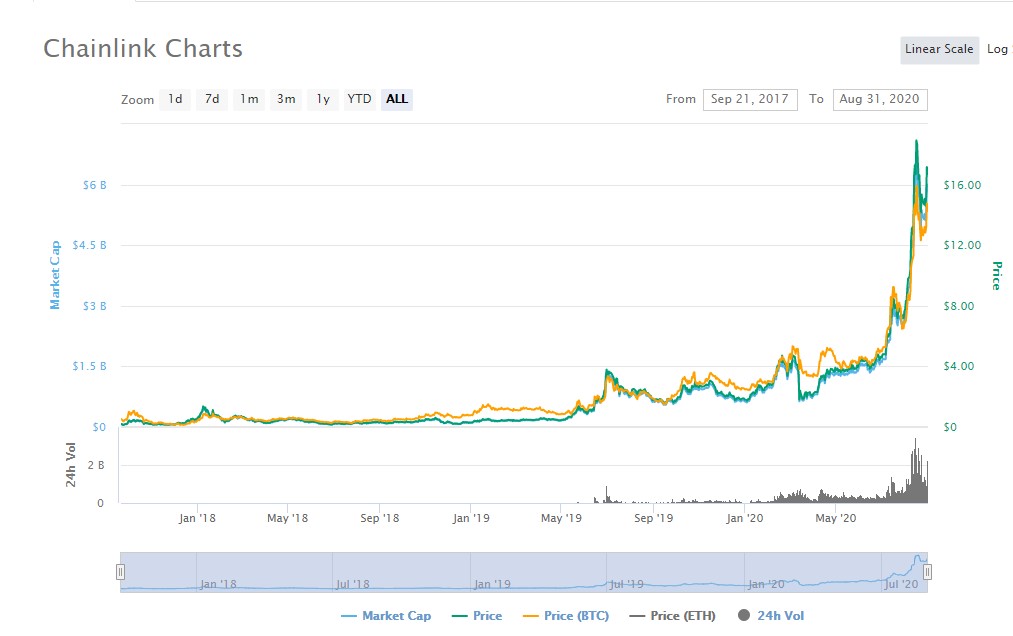
As the time of writing, Chainlink is ranked 5th with a market cap of over $6 billion, and a 24-hour trading volume of over $1.8 billion, according to coingecko. Chainlink started at $1.8 in January 2020, with a market cap of $642 million, but today, it’s trading at $16.7 – that’s a bullish 828% rise in market price.
  • Core Area of Usefulness
  • Retrieval and verification of external data on smart contracts and blockchain network.
  • Decentralized Finance (DeFi) platforms
  • What to Expect

Price predictions are becoming a bit more difficult, especially with the look of the financial market. This might be different for Chainlink as it’s already outperformed several predictions this year on many occasions, and is currently trading above the $5-10 mark forecast.

According to an AI-enabled algorithm from Crypto-Rating, Chainlink is predicted to trade at about $20 by the end of 2020, towards the turn of 2021. This is pretty much realistic and it an only get better with this project.

Recommended: As The Crypto Spring Becomes Evident,Here Are The Top 3 DeFi Leaders In H2 2020

Disclaimer: This is clearly the opinion of the author and not a piece of financial advice. Endeavour to dig deep before you make any investment in cryptocurrencies.

As The Crypto Spring Becomes Evident,Here Are The Top 3 DeFi Leaders In H2 2020

The reign of DeFi has translated to more money in the hands of crypto hodlers. Here is how you too can join the rave.

The decentralized finance (DeFi) market has experienced a massive growth over the last several months. Anyone following blockchain trends will likely know that ICOs are a thing of the past. Now, it is all about DeFi projects.

DeFi pulse statistics shows that the sector’s total value locked (TVL) is currently at $6.71 billion and grows by $500 million weekly. This is massive growth from the previous month with a TVL of about $2 billion.

According to recent published reports, the TVL dropped to $500 million in March 2020. However, this explosive growth stems from the yield farming ecosystem and the high lending interest of DeFi projects.

Just as expected in any market, this sector has its leaders. Currently, Maker, Aave, and Curve Finance are the leading projects.

You Will Love: 2020 Has Been The Year of DeFi. Here’s How It Has Given Cryptocurrencies A New Lease of Life

1. Maker

Maker Dao is the current leading DeFi project, with more than $1.46 billion of the $6.71 billion locked within this single project. Maker outperforms other platforms in the DeFi world pretty much the same way Bitcoin tops the crypto industry.

Maker is the oldest and the most recognizable name and cryptocurrency on the list. It is a decentralized credit platform on Ethereum that supports DAI – a stable coin with a USD-pegged value.

You can open a vault with Maker, lock in collateral such as BAT or ETH, and generate DAI as a debt against that collateral. DAI debt induces a stability fee (a continuously accrued interest) paid upon repayment of borrowed DAI.

Also, Maker has a unique feature called DAI Savings Rate (DSR). The feature enables DAI holders to lock their DAI into Maker’s DSR contract and receive a variable interest rate in DAI, generated from stability fees.

Maker dominated the DeFi sector with 21.78% of the TVL.

2. Aave

Aave is an open-source, non-custodial protocol on Ethereum for borrowing and lending a vast range of cryptos using stable and variable interest rates. I should also mention that the platform is entirely decentralized.

Aave offers notable distinguishing features such as rate switching, flash loan, uncollateralized loans, and unique collateral types.

It also uses a native coin – LEND – as a bargaining chip to provide holders with discounted fees. LEND is also staked for governance and as the first line of defense for outstanding loans.

Also, Aave provides the broadest range of DeFi collateral of any lending protocol on the market and takes a large share of the DeFi lending market due to its strong liquidity and the chance to protect against smart contract risk.

Aave’s flash loan feature opens the doors for safe and secure arbitrage opportunities at virtually no cost to the user.

Unlike other lending platforms that tend to lock users into a variable or fixed interest rate, Aave’s rate-switching feature allows users to switch between two different markets and earn by arbitrage.

This enables users to get the best interest rate on their loans by choosing between “variable” and “stable” interest rates.

However, these stable rates are not fixed interest rates but a rather stable form of variable interest rate, which is constant and less susceptible to market fluctuations.

Though launched in May 2020, Aave is currently ranked second and locked at $1.26 billion.

Read Also: What To Expect From The Crypto Market In H2 2020

3. Curve Finance

The Curve is also a decentralized exchange liquidity pool on Ethereum designed for stablecoin trades. It is ranked third with a TVL of $1.04 billion.

Since its launch in January 2020, Curve enables users to trade between various stablecoins with low slippage. Its small fee algorithm was explicitly designed for stablecoins and earning fees.

The Curve is also one of the few DeFi protocols to achieve exact product-market fit by fulfilling a specific purpose that market participants have come to value.

Also, Curve serves as an alternative to trading stablecoins on general-purpose DEXes such as Uniswap, whose algorithm is not optimized.

Curve also integrates with DeFi lending and borrowing platforms like Compound, dYdX, and Aave, which allows Curve users to earn interest on top of their trading fees.

Another interesting fact about Curve and other Ethereum-based DeFi protocols in its class is that they allow anyone to provide liquidity to the market.

Unlike traditional market makers that often use exchange-provided assets to provide liquidity to a market, Curve delivers to users with assets that support its market to provide liquidity.

Recommended: Are Hedge Funds Safe in Unstable Times? Here Are A Few Tips You Can Use

Conclusion

Hopefully, the reign of DeFi will lead to a further deepening of the cryptocurrency market for the benefit of investors . There is no doubt that there is more to come in the days ahead.

2020 Has Been The Year of DeFi. Here’s How It Has Given Cryptocurrencies A New Lease of Life

DeFi has redefined how finance works in today’s world. With blockchain enjoying a world of its own, investors around the world have poured in hundreds of billions of USD to reap the rewards here.

Photo by Pixabay on Pexels.com

How Decentralized Finance Works in Crypto

Decentralized Finance or DeFi for short, is an inclusive and remodelled open finance format that typifies the unification of decentralized technologies (like the blockchain) and traditional banking systems. Simply put, DeFi systems aim to provide substitutes for existing financial services in the aspects of loans, insurance, savings, asset trading and lots more.

DeFi is largely dependent on decentralized applications (Dapps) on the Ethereum blockchain, and to understand its capabilities, the concept of Dapps must be adequately understood. 

Read Also: Here Is How Cryptocurrencies Have Become The Norm For Money Transfer

How Important is DeFi?

The importance of DeFi in the evolution of financial systems as we know them, cannot be overemphasized. This open finance format offers huge prospects for the expansion of global economies, and since 2019, it has been considered one of the most significant and rapid advancements in the cryptosphere by analysts.

Recent reports have also revealed that DeFi tokens are, without cessation, outstripping their compeer, having surged by over 200% since the start of 2020.

DeFi Apps and Crypto

At the moment, DeFi apps have grown in popularity and are already securing businesses, money and time. The emergence of Decentralized Finance platforms has become evident in virtually all parts of the financial sector, inclusive of cryptocurrencies. All DeFi apps are transparent, open-source, interoperable, flexible, and permission-less, as seen in numerous Ethereum-based projects. 

In the crypto sector, decentralized exchanges are perceived as the next big thing towards achieving the desired evolution. Decentralized exchanges (DEX) will eliminate the chances of theft and exchange hacks that have plagued centralized systems.

When crypto assets are traded on a decentralized exchange, the transactions are facilitated by smart contracts rather than traditional intermediary systems in centralized exchanges.

Smart contracts protect crypto transactions on the blockchain and ensure that the entirety of the system is not vulnerable to hackers. The DeFi ecosystem isn’t just flourishing, it is quickly changing the business approach of established institutions, while also facilitating the emergence of thousands of crypto projects.

Recommended: Despite The Marketplace Twists,Thorns and Thistles, Here Is How USDT Has Weathered The Storm

Here are some of the most exciting and interesting projects, in no particular order, and of course, by no means exhaustive.

1inch

Before the emergence of tokens and smart contracts, cryptos were normally traded via exchanges. Due to this, exchanges have enjoyed massive growth and have become major players in the crypto world. The surge in the popularity of Ethereum, created Decentralized Exchanges (DEX), and ever since, more DEX projects have launched on the ETH blockchain.

1inch improves on the existing concept by taking it a little further. To be more explicit, 1inch is a DEX aggregator that scans through all the DEXs on the Ethereum blockchain to obtain the best prices for any asset as desired by the user. 1inch offers a powerful tool, especially for users who are in the market for the best price margins.

One way to get the best of crypto investments is to research and purchase yet to be launched token on major centralized EXs. Being on the ETH network, purchasing 1inch tokens before they debut in large crypto economies, would be an excellent choice.

Recommended: The 7 Must-Know Rules of Cryptocurrencies and Stock Market Investment

Curve

Having kickstarted in 2019, Curve is another amazing DeFi application in the cryptosphere. It is an exchange pool built on the ETH blockchain, that utilizes bonding curves, and specifically designed to support and boost the trading of stablecoin (DAI, USDC, USDT and TUSD), while also providing low-risk income fees for liquidity merchants.

With Curve, users do not experience price fluctuations as they normally would on DEXs, when swapping one stablecoin for the another. In the case where assets on other DeFi platforms, especially Compound, are not being traded, Curve lends the assets and return interests to providers of liquidity.

Curve is accessible on mainnet via curve.fi and it supports DAI, USDC, USDT and TUSD. Trading and depositing are facilitated by MetaMask, a web3 wallet.

Compound

At the moment, Compound is a top-rated DeFi project, and it offers users the opportunity to borrow ETH tokens and payback with interests. Liquidity providers could also come into play by providing their token for loan purposes with the aim of receiving loan profit.

This platform offers huge profits, and at a time like this, where savings in traditional banks give little annual interest or lost to inflation, Compound becomes a lucrative option. Compound is intuitive and well-designed and can be accessed via mobile wallets or online channels.

Uniswap

This is an innovative automated market-making DeFi platform with a protocol that enables ultra-swift trade settlement between parties. The Uniswap protocol ensures that, as much as possible, the closing trade value of assets reflect their real market value. You can become a liquidity provider with amazing interest rates provided via a dedicated pooling feature.

Summary

As the major sectors of the global society tend towards decentralization, the demand for DeFi applications will no doubt skyrocket in the nearest future. At the moment, DeFi continues to remarkably disrupt and dictate the pace of today’s business systems, while also dictating new standards.

You Must Read: The 10 Leading Stablecoins of 2019 and What You Should Expect

Here Is How Cryptocurrencies Have Become The Norm For Money Transfer

Crypto beats fiat as a result of its flexible governance structures. With no Central Bank to look to, these digital currencies have taken on a new life as money transfer vehicles.

Photo by Crypto Crow on Pexels.com

Is the crypto option for money transfers here to stay? Here is what you need to know

Cryptocurrencies have become the new normal of money transfers. It is gradually becoming a thing to request a cryptocurrency wallet address rather than a bank account number when trying to transfer funds between counterparties. The reasons are obvious.

Crypto payments are fast and secure due to the cutting-edge technology of the blockchain. Also, transaction costs are minimal, making it a good choice from a business perspective since both sides get to keep the part of the payments that would have gone to settling payment transfer costs in a regular wire transfer.

Crypto transfers seem to be here to stay given all their benefits. However, there are existing limitations you need to keep in mind before converting all of your cash to BTC or ETH.

Reach

Despite having been in existence for more than a decade, cryptocurrencies have still not been adopted globally by most people. As at the beginning of the second quarter of 2020, there were 50.71 million blockchain wallet users worldwide, in contrast to well over a billion regular bank accounts. At this point, one would realize that there is a huge gap to be filled.

This is something to keep in mind as most people do not have cryptocurrency wallets, and you can’t transfer to them without one. A suggested solution is to try to open the conversation with clients or suppliers or any other business counterparties, encouraging them to open a blockchain wallet and make your business transactions seamless.

Price stability

This is a major issue with cryptocurrencies. Imagine getting a transfer of say 2 BTC worth $18,000, and just before you’re able to either pay for another product with it or convert it to a fiat currency, the value drops to $12,000, which is a $6,000 loss on a single transaction.

Also Read: Despite The Marketplace Twists,Thorns and Thistles, Here Is How USDT Has Weathered The Storm

A way around this is to transact in the stable cryptocurrencies known as stablecoins. The USDtether, for example, is tied to the value of the US Dollar. Tether cryptos are not as subject to volatile swings in value as other cryptocurrencies and this makes it safer to use them for transactions.

Government regulation

Some countries have strict regulations that limit the volume or usage of cryptocurrencies by law. For example, Binance was created in China but had to move to Japan due to issues with regulators. Be sure to confirm if there are no restrictions on the use of cryptocurrencies either within your own country or that of your counterparty.

Photo by Launchpresso on Pexels.com

Platform Security

The safety of blockchain only guarantees that transactions and their history cannot be tampered with. Beyond that, your wallet is vulnerable to the extent to which you can protect your account. If malicious hackers gain access to your account passwords, your cryptocurrency funds will be lost. Hence, it is important to secure your wallet either through 2 Factor Authentication (2FA) or Authy.

As long as you keep the above factors in mind, the blockchain and cryptocurrencies ecosystem will make your experience with transferring money seamless even across borders.

Recommended: What To Expect From The Crypto Market In H2 2020

What To Expect From The Crypto Market In H2 2020

The crypto scene has been abuzz with upbeat signals as 2020 H1 came to a close. What does the H2 hold? Let us delve in here.

Photo by David McBee on Pexels.com

2020 has been an eventful year with lots of events having ripple effects on the financial markets and cryptocurrencies by extension occurring in rapid succession.

From the threat of world war 3 to the pandemic, these events have triggered wild movements in stock and commodities prices and cryptocurrencies have not been left out of these price actions as well.

Read Also: Despite The Marketplace Twists,Thorns and Thistles, Here Is How USDT Has Weathered The Storm

Going into the second half of the year, what can we expect to see? Below are some speculations:

Increased Adoption

Cryptocurrencies have come a long way from being considered a fringe technology. Just in the first half of the year, there was an additional 5 million blockchain wallets created, increasing the global number of cryptocurrency users from about 45 million to just over 50 million.

These wallets are held across various exchanges like Remitano and others. It is predicted that this figure will rise even more sharply as we commence H2. The utility, speed, security and seamlessness of cryptocurrencies and blockchain technology will attract even more people to sign up and get involved in the ecosystem.

Penetration into emerging economies

Emerging economies hold a lot of potential for the expansion of the cryptocurrencies market. Remitano, a crypto exchange created in 2014, seems to have realized this and have tailored its operations to capitalize on the possibilities in these markets.

With operations in countries like Nigeria, Cambodia, Vietnam, Cote d’Ivoire, Thailand, Tanzania and Zimbabwe, among others, it can take advantage of reaching a great number of unbanked or underbanked people.

Crypto markets will offer them the technology-enabled ease of transacting with cryptocurrencies rather than the regular fiat currencies. Remitano is also introducing an NGN wallet, based on the Nigerian fiat currency – the naira. This will make it even easier for citizens to purchase cryptocurrencies, and it is expected that this will be extended to other emerging economies before the end of 2020.

Launch of Facebook’s Libra

Despite all the controversy surrounding it, Facebook still seems on track to launch its cryptocurrency, Libra, by the second half of 2020. There has been a mixed reception to the idea with some people considering it a good idea and lots of other parties opposing it. Whichever side you’re on, Libra’s launch is something to look out for in the second half of the year. It will be interesting to see how it all plays out.

Adoption by more countries

China is said to be close to completing the creation of a national digital currency – an unprecedented step that will make cryptocurrencies even more popular, and perhaps, drive its adoption among other countries. The Chinese digital currency will likely be launched by the second half of 2020, and it is surely another event to look forward to.

Finally, we expect that the usual volatility in the crypto markets will continue into the second half of 2020, as major events like reopening and the American elections will swing market sentiments in different directions.

Recommended: You Can Improve The Profitability of Your Business With Accurate Records. Here Is How To Do So