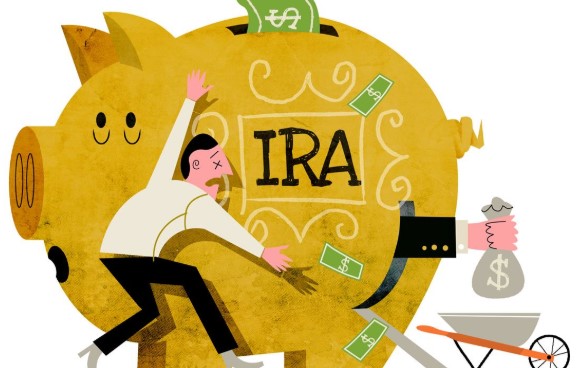
IRAs are gaining attention around the globe. How best can you optimize them? That is the subject of this guide.
Best Hacks On Self-Directed IRAs
In order to understand the basic
misconceptions about the IRA, we first need to have a full grasp of what an IRA
is, and what is the major difference between traditional and self-directed IRA.
An IRA or Individual Retirement
Account is a way to save money for post-retirement with tax-free benefits. It
is an investment option designed for building saving funds for the time of your
retirement.
The concept of self-directed IRA has
been introduced for quite a long time now, but people are still not comfortable
with the idea and have various concerns about it.
There are multiple misconceptions about the
use of funds in self-directed IRA that should be clarified for the better
understanding and benefit of common folks
Self-directed IRA is a magnificent
financial tool that can help you to generate a huge amount of wealth easily and
legally. It opens a huge range of investment options for you that can have huge
valuations for your portfolio.
Traditional VS Self Directed IRAs
There is a very small but major
difference between the two types of IRA. The difference is about the authority
of the custodian about the investment restrictions in either type of IRA.
The custodian has a much more active
role in traditional IRA, and it decides the investment direction of your funds.
It usually allows people to invest only in areas like bonds, stocks, annuities,
and mutual funds, and no other form of investment is welcomed.
Whereas, in self-directed IRA, the
custodian doesn’t have that much active role in investment options. The
custodian’s responsibilities are limited to mainly tax management and allow you
to manage your investments as you desire.
Hence, for self-directed IRA, one can have multiple investment options, in addition to the traditional options, like real estate investment, new start-ups, cryptocurrency, etc.
Self-Directed IRA Misconceptions
Many people have certain misconceptions about the mechanism and processing of the self-directed IRA.
These misconceptions misguide them badly and lead to bad investment decisions and negative financial consequences. So, here we have enlisted all these major concerns to clarify them once and for all.
1. The first misconception is about investment options. As discussed above, traditional IRAs have a limited room for investment options. The reason for the fixed policy is that conventional markets are relatively easier to engage with and monitor compared to alternative options.
For example,cryptocurrency is a very risky investment option that can be unacceptable for traditional IRAs. On the other hand, the self-directed IRA has no such issues and are open to every kind of investment option.
2. The next misconception about self-directed IRAs is that these firms have absolute authority over the money. Whether traditional or self-directed, no IRA firm has any such authority. Their mere responsibility and control are about keeping your money safe.
They can’t invest your money without your permission, and even after investing, you have the authority to cancel their access to your funds.
3. Another common misunderstanding of people is that real estate investments in self-directed IRAs could be used personally. It is not true at all. The only purpose of the IRA-based real estate investment is to make a profit. You can’t use the property or live in it.
4. The biggest misconception of self-directed IRAs is about their legality. The non-traditional investments are generally considered illegal.
Cryptocurrencies, tax liens, venture capitalism, etc. all these are legal forms of investment, where markets are regulated by safety measures and laws.
Uncertainty is at the core of investment. Just because alternative investment options are not widely discussed doesn’t elevate them as riskier than traditional methods.
Real estate is the safest investment option while cryptocurrency is volatile but not overly risky.
Even in traditional investment options like bonds
and stock, uncertainty is inevitable. The more you concentrate on one specific
market the higher the risk will be. In any investment market, the simple and best
way to avoid risk is diversification.
Conclusion
The self-directed IRA makes you more empowered concerning your fund investment.
You have more liberty to make more money compared to traditional methods by adopting alternative ways.
Take advantage of the greater options and the possible gains available for you and get benefited excessively in your future.
Facebook is drawing some ruckus around the globe with its Libra project. Is Libra already second-placed in the crypto world? Find out.
While Facebook is criticized for its lax approach towards privacy and the often-toxic business practices, it’s still one of the most important companies on the web. Just by the amount of users it boosts – 2.38 billion as of January 2019 – anything championed by the giant will gain lots of attention and traction.
Knowing that, it’s not surprising Facebook’s attempts to create its own cryptocurrency have gathered lots of press. In fact, after Bitcoin, Facebook’s fabled Libra project might well be the second most talked about crypto project in the mainstream.
But, does that buzz around it translate to the cryptocurrency actually being successful even before any details about it are officially unveiled?
Very
little is known
Here’s the first fact: We know nothing about the Libra project. Other than a few of those involved, but not necessarily behind it, there’s no official information whatsoever.
At this point, all we know for sure is that Facebook is pursuing its own cryptocurrency. Everything else are rumors or assumptions.
This is important because, while many of these rumors might be true, this means that it’s all speculation at this point.
That works for the crypto market, since it’s largely speculative, and it keeps the Libra project in the news, which we’re sure Facebook likes, but… it doesn’t do much more than that.
And even how much it helps the Libra project in the crypto market can be argued, since all the rumors in the world won’t matter once an official announcement is out there.
Since the cryptocurrency can’t go on sale without such an announcement, all pre-release rumors and hype won’t really affect Libra’s success in the end.
Then, there’s something else: One of the chief rumors says that Libra will be a stablecoin. Which in turn means the token won’t be able to gain or lose value, no matter how well designed it is.
As mentioned, since the token is
believed to be a stablecoin, nobody is waiting to spend a fortune buying Libra
tokens. Instead, what the crypto community is buzzed about, is how such a
stablecoin could help drive crypto adoption.
Facebook’s reach is unprecedented for
the crypto market. If Facebook pushes libra and gains many adopters, that will
mean the crypto adoption rate will shoot up – which should in turn drive many
people towards trading other cryptocurrencies.
In other words, the buzz in the community is about Libra working as a gateway cryptocurrency, but not so much about Libra being a game changer.
What
ranking might mean
Now, that doesn’t necessarily mean
Libra isn’t ranking highly. It just means whatever buzz it has now might well
disappear before it officially releases.
But let’s assume it does have huge
amount of buzz – then we should ask ourselves, what does “ranking” mean?
Regularly, ranking would be
interpreted as market capitalization. However, since Libra isn’t out yet and it
won’t be running an ICO, that would be impossible. Libra’s market
capitalization is effectively zero.
There are other ways to assume
ranking. Google search ranking is another one – one could reasonably believe
that, due to the buzz around it, Libra is being constantly googled. This would
be an interesting measure and give us insight into its expected success.
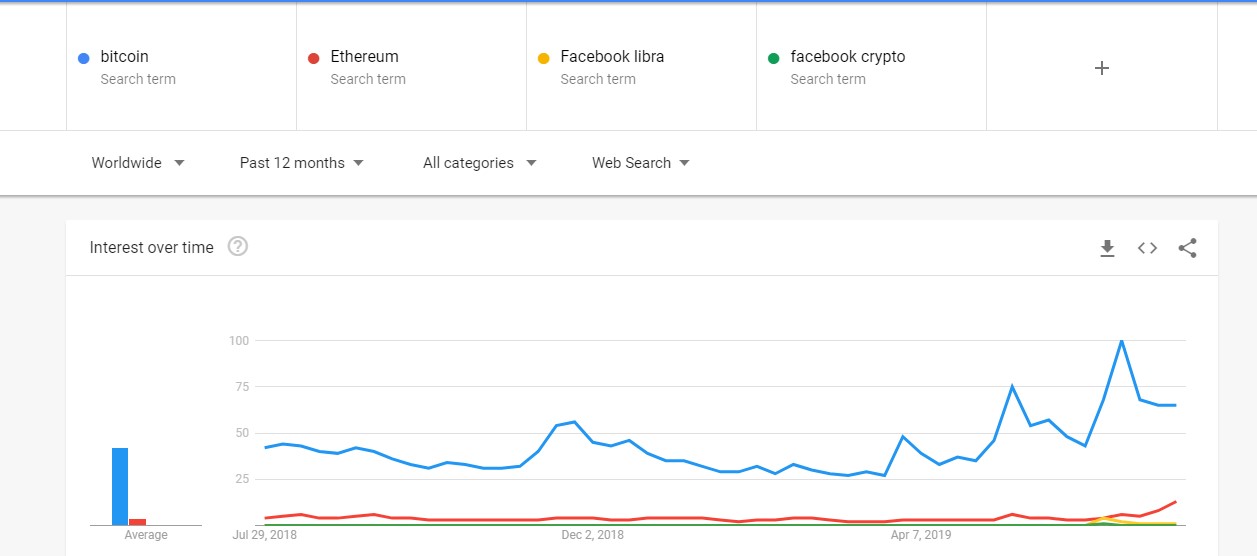
However, actual data quickly
proves this to be wrong. Actual search stats put the Libra project behind
both Bitcoin, Ethereum, and XRP, making it at the very least #4. To be fair, it
does rank
above Zcash.
Google Trends for Libra, Bitcoin, Ethereum and Crypto.
Another way to think about it is by how much it appears in the news – and it’s only here that Libra does rank well.
Bitcoin has been mentioned in 44,800,000 news items over the last month. Ethereum has been mentioned about 3,960,000 times. Facebook Libra? 8,860,000 times.
But while news coverage could be
considered rating, that’s hardly a measure of success. It’s a measure of
interest from news sites, which sure is important, but it doesn’t reflect
market tendencies.
Does
it even matter?
It’s impossible to gauge how
successful Libra might or not be without knowing anything about it before. And
even knowing, we won’t know about its success until it is out, and we start
seeing real numbers.
This is important, because while Libra has potential right now the buzz is in part thanks to the air of secrecy around it.
That secrecy might work in its favor right now, but it’ll only help in the long term if the project delivers. And we won’t know that until later this year.
So while it’s hardly true that Libra is ranking as #2 crypto, that doesn’t matter right now.
What does matter is that it’s gaining some buzz – and that said buzz could well drive its adoption once it is launched.
The cryptocurrency industry is still relatively new, and as such, concepts and patterns are still emerging. As an investor, here are some vital insights you need to know.
Presently, cryptoassets’ price co-movement is quite high, most probably due to the launch of the cryptoassets market and the participants’ weak pricing ability.
Almost 7% of these cryptoassets are held by the institutional investors, which makes an almost one-thirteenth portion of the U.S. stock market’s institutional holdings ratio.
The high turnover rates of cryptoassets as compared to the traditional markets indicate that the crypto asset industry participants are either more active or reactionary.
Studies have
found that the low internal correlation between some of the cryptoassets can be
due to three major reasons:
Idiosyncratic
factors: These are the project-specified catalysts and news that can affect
the level of correlation between cryptoassets.
Binance
Effect: Usually the digital assets that are listed on Binance have a high
correlation between them, whereas, the assets that are not listed have low
correlations compared to the former.
Consensus
Mechanisms: The consensus mechanism of cryptoassets can have a high impact
on its correlation with the other cryptoassets return.
The overall correlation in the cryptoassets market has observably increased. It can be due to the gradual decrease of the market’s Bitcoin dominated trading pairs reliance or the simultaneous rise of the volume of stablecoins across all cryptoassets markets.
The correlation cycle among cryptoassets and the effect that market structure can have on this cycle is discussed further in the following:
1.Cyclic Moments and Turning Points
One of the factors responsible for the continuous fluctuation of the correlation among the USD price of cryptoassets is market irrationality. The market rationality has a similar effect as the co-movement phenomenon or herding effect.
Studies show that when the correlation among altcoins reaches a specific point, the Bitcoin trend for USD either reverse or comes to a halt at the previous price. This indicates the emergent market’s inherent traits as well as the irrational behavior of the market participants.
However, it is very early to say that there is some causal relationship between market reversals and peaks in correlation.
2.Disproportional Percentage Of Retail Investors
The frequent extreme correlation periods of cryptomarket are related to the highly retail-driven participation of the market. According to the recent data, almost 700 crypto funds are operating in today ‘s cryptomarket, but the January 2019 asset was thought to be $10 billion only.
Assuming that all of them hold only Bitcoin, the total upper bound of the Bitcoin market value will be 14% only. But if Altcoins are also included, the overall institutional proportion for the cryptoassets market can become even less than 7%.
It can be said that non-professional investors can become overtly cynical or overconfident while reacting to market trends. And that can lead to a high potential transactional volume and more volatile prices.
Whereas, crypto investors are more attentive and active towards new developments in the market, they have a significant impact on the success of their participating crypto networks and promote their voice to get heard, even through simple price action.
3.HODLing by Crypto Investors
HODLing refers to the phenomenon of the crypto investors where they prefer to HODL their assets when there is a decline in price until the prices are recovered.
And they become active when the high prices are restored. Most crypto investors tend to HODL the currency in bear markets that lead to moderate changes in UTXO cap.
But the UTXO cap decline can go steeper if the individuals transact with Bitcoin at comparatively low USD value prices. Not to ignore the fact that after a certain bear period, the rate does not go up that quickly, until at least the underlying rates reach the previous heights.
Herding behavior effects are situation specified. The initial correct information will cause a herding effect to reflect the information more quickly in the price.
Comparing this to
the traditional market, the cryptoasset market has faced several issues during
tits small lifetime, like:
-There is a lack of popular trading instruments of the market, an absence of a compulsory mechanism of disclosure that should be followed by all the market participants, and inadequate protection measures. All these factors lead to a reduction in the enthusiasm of the investors.
-The highly complex blockchain industry has a high barrier for new entrants. Also, there is a lack of professional and reliable media sources that leads to slow transmission of information and even extensive fake news dispersal.
-The limited arbitrage channel is another problem. The inherent limitation of cost of the mainstream coins or speed of transfer, temporary paucity of appropriate derivatives and an in-depth, and regulatory restrictions imposed by many countries lead to asset prices stymieing for a long time period in an unreasonable state.
However, the cross-exchange arbitrage chances were seen to be decreased during 2018, resulting in a higher price efficiency.
Takeaways
Because of the above-mentioned aspects, the effect that quick reacting market participants have become more distinct, making it more difficult to price the individual cryptoasset accurately.
Therefore, the herding behavior or so-called irrational attitude must not be blamed only on the inexperienced participants, but the market immaturity and infrastructure should also be on the front burner.
Especially after
2018, many regulatory bodies, media outlets, and research institutes have
started to pay more attention to the blockchain industry. Also, there is a wave
of crypto-native research and coverage growing with every passing day.
This rapidly
developing industry has been able to attract new support and funds from various
traditional and governmental capital sources and seems to continue doing so
with every new step of improved data, news reliability, regulatory clarity, and
less usability friction, which leads to a market with more efficient price
discovery as a whole.
Various ongoing and completed researches and studies provide enough data to analyze and assess the progress of the space during the last few quarters.
As many mature financial products get rolled out, which covers the industry, there is a clearer worldwide regulatory framework, which means a rapid maturing of the crypto market than ever.
Gb Adolph Obasogie is the CEO of Harrison Global Capital
The news made ripple as you would often expect in the crypto world whenever any mid to large-size established company jumps in.
TD Ameritrade started a formal crypto division. While the move was somewhat expected, since it had already invested in crypto exchanges, the news still left many people wondering: what does this mean?
What is TD Ameritrade?
In order to know
whether this move matters or not, we first need to know the company we’re
talking about.
TD Ameritrade is a long-established American broker. With almost fifty years in the market, its mission is to help customers both buy and sell all kinds of stocks, funds, and futures.
In other words, Ameritrade is a very large stock trading house, one with established success in the business.
While this might look as just another financial company trying to break into crypto, the type of company matters a lot this time around.
As we have mentioned in many of our articles, the crypto world is a lot like the stock market. Crypto exchanges, and many crypto investors, work in more or less the same way stock traders do.
So when a company renowned for stock trading options joins in, it can’t but be important. The fact that such a company is jumping into cryptocurrencies means two things:
Its managers see a future to cryptocurrencies,
and
They feel the market has settled and is stable
enough that they can start offering their expertise without risking much.
Both of these
things are huge, since many traditional economy-related businesses have shunned
crypto, and at times even outright tried to sabotage it.
But TD Ameritrade trades in
many things, doesn’t it?
Yes.
TD Ameritrade works both as an exchange of sorts and as an investments company. Its goals aren’t just to commercialize stocks and values, but to help those looking to invest find the right things to invest in.
To attain this, it offers customers several both premade and customized portfolios containing mixtures of stocks, funds, futures, and now crypto its team of experts consider good investments.
The advantage of these services are huge for clients who don’t know the stock market inside out. With Ameritrade’s guidance, they can choose where to put their money following the advice of leading experts in the market.
This helps minimize, although not eliminate, the risk involved in investments.
TD Ameritrade also offers many specialty plans dealing with managing both one’s own finances and one’s economic future. Customers get help not only investing, but also managing their properties and assets. TD Ameritrade thus seeks to help its customers optimize their own portfolios.
For more knowledgeable customers, it also offers personalized portfolios where they can choose exactly what to invest, although always while receiving advice from professionals in the area.
How important is this for crypto? Is it important at all?
In a way, it’s
huge.
One of the main problems with cryptocurrencies is driving adoption. Many people who have thought of investing in crypto have found the whole blockchain-related environment much too confusing.
Even people who are used to trading in the stock market can feel taken aback when talking about private wallets, public wallets, wallet keys, nodes, mining, and so on.
With this move, TD Ameritrade is allowing its customers to invest in cryptocurrencies without needing to know all this.
It’s also offering professional guidance in the process, both to minimize the risk any newcomers face and to help them understand how the crypto world moves.
What this means for the crypto world is that as of now millions of accounts managed by Ameritrade can jump into cryptocurrency investments.
This doesn’t mean that many people will, or that they will even display any interest in it, but that they have the option to.
In other words, there’s now a simple way for people not in the know to invest in cryptocurrencies.
So is this a game changer? Is
mass crypto adoption about to happen?
Let’s slow down.
TD Ameritrade
entering the market is big, yes. But not necessarily as big as to drive mass
adoption on its own. This is but another step towards that goal, but there’s
still a long way to go.
First, because
we don’t know how many of TD Ameritrade’s customers will actually invest in
crypto. For all we know, Ameritrade might roll out this platform only to have
it fail to attract any relevant interest and become just another offering with
relatively low adoption rates.
Sure, the
opposite might happen. It’s always possible Ameritrade’s customers will be
thrilled to hear they can now invest in crypto and rush to their services,
causing the beginning of a new crypto rush that drives all prices up and leads
to a golden age of cryptocurrency.
But being honest, that’s very unlikely. However, TD Ameritrade’s VP has stated his company’s customer base is very interested in crypto investments.
Whether this is true or just a comment to hype up the crowd and help drive adoptions we can’t know, although it does mean the firm is expecting their new program to do well.
So, to be honest, we should keep our expectations tempered about this. It’s a big thing simply because it marks a new household-level investment company joining the crypto world.
This means trust in the market is growing, which at the same time means we’re one step closer to mass adoption. It also will help drive more crypto adoption, but you shouldn’t expect it to cause a rush.
Can I buy any crypto I want
with TD Ameritrade?
No, you can’t.
TD Ameritrade, and most brokers, will only trade in select stocks considered by their experts to have relatively low risk.
While it does have high-risk offers, they’re usually offered only to clients who specifically look for them, and even then, they tend to come from already curated lists that ensure a certain degree of predictability.
This is because Ameritrade, as any brokers do, wants its customers to have some success in their investments.
It doesn’t look good for a broker to have many clients who end up losing their investments, particularly if they count the elderly among their main demographics.
So even when offering “risky” investments, TD Ameritrade will want to limit the risk.
The crypto
market, as we know, isn’t particularly stable. Any crypto investments offered
by Ameritrade will be considered high-risk right away, due to the
unpredictability of the market. Allowing customers to invest in about any coins
will only make it worse.
That’s a ridiculous number, and making customers browse through such a list trying to understand what each of them is and get a grasp of the risk involved wouldn’t be an option for any brokers.
Also, the vast majority of those cryptocurrencies would make for really awful investments nobody would ever recommend even to their worst enemies.
In the spirit of
making it easier for their users to understand what they’re getting and to
avoid them going bankrupt, TD Ameritrade is for now only
offering Bitcoin and Litecoin.
Is there any logic behind these
choices?
Yes, although it
might not be the kind of logic most crypto users would follow.
Bitcoin is there mostly because it’s easily recognizable. Also, because it’s been relatively stable over the past year, with a tendency to rise the last couple months. But most of all, people know about it.
General media often uses “bitcoin” to mean cryptocurrencies in general, and while most people might not know what Ethereum or Ripple are, they do have a grasp of what Bitcoin is. After all, it was all over the news just a year and a half ago.
Bitcoin is
indeed unstable, outdated, slow, and it will never become the crypto for
widespread use. We know that. But many of the people looking into crypto will
go straight for Bitcoin, because that thing was once worth almost $20,000 each.
Also, Ameritrade is offering crypto as an investment solution, meaning users getting it through them will mostly be parking it.
They won’t buy and sell stuff with it, since that’s not the goal its customers are after. Since Bitcoin is well-known and has kept a stable price with a tendency to rise this past year, it’s an easy choice.
As for Litecoin, it has been on the market for long, has a decent price record, and once again has been rising this last year.
Being a fork of bitcoin, it also isn’t likely to ever attain mainstream use. But once again, this is investment. These people will see it as a value, not a proper currency.
The fact that
Bitcoin’s value is mostly based in expectations and isn’t actually tied to
anything other than public perception doesn’t matter either. As long as its
value keeps going up, people will want to invest in it.
Will this affect the market?
It sure does.
Part of Bitcoin’s rise over the past two months can be attributed to this, among other things. BTC is currently experiencing a bit of a renaissance thanks to several projects being launched around it.
The fact that the crypto market is quickly growing into maturity and BTC’s price is basically an indicator for public trust in crypto also helps.
Should we expect this rise to
continue?
We can’t tell. There are currently actors predicting another BTC rise, along with a rush to $50,000, but the last time such a thing was predicted it was quickly followed with a crash once the bubble burst.
Since bitcoin’s nature is that of a bubble, it’s better to remain wary of any extremely positive predictions.
It might even not be in the crypto world’s best interests to have Bitcoin grow too much, in fact. BTC is known for being outdated, and the sooner another, newer crypto takes over the market the better.
BTC reaching a ridiculously high price will make this very, very difficult – which would in turn make widespread use and adoption of crypto about as difficult.
On the other hand, BTC creating another bubble and bursting would be even worse. Crypto already had a terrible 2018, and it’s only now recovering and making it to the news again.
Another quick price drop would erode public trust in crypto in general, which would greatly slow down general adoption for crypto.
The best we can expect is for BTC to keep rising… a bit. And then stabilizing. A stable market is a requirement for widespread adoption and use.
People can’t trade using a coin that’s constantly changing its value, after all. BTC stabilizing would help bring stability to the market as a whole, which might lead a few high-profile companies to start accepting some cryptocurrencies for payments.
If enough of these companies do so, we’ll start seeing widespread use of crypto.
Adolph Obasogie is a Partner at Harrison Global Capital. Get firsthand info from help@harrisonglobalcapital.com
Rideshare needs a redefinition, and blockchaincan make a difference.
The Need for a Blockchain-Driven Ride Share
Anybody with a smartphone and one of these company’s application can easily communicate with logged drivers to order for rides that correspond to the routes of operation of that particular driver.
It is general knowledge that ridesharing has gradually crept into our lives and culture and become integrated into our daily movement and way of operation.
The application network serves as a platform to develop a sense of responsibility and trust between the drivers and the passengers.
There are now companies that have risen above order and serve as the frontier for this industry. Companies like Uber and Lyft have erupted in popularity and financial alike.
The Multi-billion Dollars Business
Typically, companies like Uber and Lyft has become household names and risen to the status of top brands and companies to be reckoned with around the world.
They are the top players in the space of ridesharing, with Lyft being valued at $15.1 billion and Uber valued at about $72 billion.
Those are large chunks of market share and these platforms have weathered the storms of criticism until now.
Although opposition to ridesharing services has come under the light of skepticism in functionality and structure, more needs to be done.
Uber, for example, being banned in major cities around the world like Barcelona, Vancouver, Frankfurt, and some other cities.
The major antagonists to ride share service companies have been Public transport services and Taxi companies, as ridesharing takes away a large chunk of their consumer market.
Although right now, is not an only taxi and public transport companies that they have to be cautious about because they are on a route to being out of the market by new innovative companies using Blockchain technology to revolutionize the space.
These big companies hence face a giant hurdle in terms of Blockchain technology and how it can seriously hurt their business model.
What Does Blockchain Do?
Blockchain has become quite popular in today’s world probably because of bitcoin and it’s outrageous pricing in 2017, but let’s talk about the blockchain framework itself.
So, blockchain offers a decentralized, open, and distributed ledger that records transactions between two entities inaccessible, retrievable and permanent fashion.
Each of this growing transaction is linked to one another using cryptography. These transactions are extensively secure and usually do not require the third party and hence are more cost-effective.
They could be much cheaper than traditional ridesharing platforms and therein lies the punch that could potentially knock out the big players like Uber and Lyft.
How Blockchain can Influence Ride Share
Talk about a disruption much like the Internet did in the late 1990s or the airplane by the Wright brothers in 1903.
Blockchain is here to stay and is currently reshaping and redefining the ways people view and understand companies & industries today.
The ridesharing landscape is not left out on the list of industries being disrupted. Of course, the only major hold back for now is worldwide adoption of Blockchain and cryptocurrencies.
These companies, Uber, Lyft, Wings & Sidecar operates a centralized system. They are actually called Aggregators because what they do is, they serve as intermediaries between the drivers and potential customers.
The customers or passengers order for a ride on the company’s application on their smartphones with specific directions and the company supplies a list of drivers with different ratings for you to select from.
Then you choose the driver and pay through the same application on your smartphone.
The company then receives the money, take a percentage and pay the driver. Hence these companies serve as a centralized site for the linking and completion of the transaction.
They usually have the software, routers, and servers for reception and distribution of these orders.
What the blockchain framework can do in this space is to eliminate the middlemen or intermediaries, in this case, being Uber, Lyft, or Wingz. Blockchain creates a decentralized ledger that stores transactions securely in blocks.
And each block having a time stamp of the previous one so that they are linked, and one cannot be accessed without going through the other. Hence, this provides a fortified and impenetrable network.
Due to the fact that the data is not stored in one place but dispersed through a network of computers, there is no aggregator or centralized unit needed.
Providers of driving services can simply provide a profile of the routes they cover ratings by previous customers, charge, and connect straight to passengers on the blockchain platform
The passenger can request a service, then the Blockchain platform could filter according to the categories and produce a list from which he can choose from.
Although there are still some touches to be added to this model before it becomes functional. But it’s a highly better alternative to the traditional.
The transaction or payment end can be done through the peer-to-peer payment technology already built into the system.
Regulation of Ride Share Companies
These rides share service companies have come under heavy criticism to be regulated by a designated government body.
Reason being that there has been reports of cases where drivers have assaulted and been violent toward passengers, there has also been much talk over the inspection of Uber vehicles to ensure the safety of users of the platform and insurance coverage of the vehicle.
Also, there is the fee that the companies deduct from the payment before paying the drivers.
All these can be highly minimalized with blockchain as there would be little or no charges as the transaction would occur directly between the drivers and passengers, and there would be more stringent measures to monitor insurance covers and the general safety of Users.
Conclusion
It is certain that the ridesharing space is going to disrupt as the full adoption of Blockchain services begin to play out in the coming decades and traditional rideshare service companies need to take note of this or else they would be out of business by this force.
Blockchain-driven rideshare service is going to be a plus to the services being offered and hopefully, will be the change that people want to see.








 Harrison Global Capital