How Cryptocurrency Investment Works With Grayscale Trust

Grayscale Trust made the headlines recently when it emerged that the firm was selling its ETH investment higher than the market price of retail ETH. Yes, it was for a good reason. Its trust has a ROI that beats the market. Here are more insights.

Photo by Worldspectrum on Pexels.com

How to invest in Grayscale Trust Crypto

The Grayscale Crypto Trust is the world’s largest and fastest-growing crypto and digital asset investment product, with $7.5 billion in managed assets as at the end of September 2020.

Grayscale offers investment exposures and well-researched market insights into developing crypto assets that enthusiasts and individual investors can purchase and sell off on their brokerage account.

The Grayscale Crypto trust portfolio offers several crypto products, with its Bitcoin Trust being the largest selected investment by far, accompanied by its Ethereum Trust. Other products include Litecoin Trust, Bitcoin Cash (BCH) Trust, Stellar Lumens Trust, ZCash Trust, Ethereum Classic Trust, Horizen Trust, XRP Trust, and Digital Large Cap Fund (holds multiple digital assets in one portfolio).

What does Grayscale Trust Crypto offer?

It is a portfolio of cryptos that provides alternate means of investment to specific investors, intending to secure their investments from market uncertainties, while precipitating positive yields regardless of market bias.

To better understand this subject, let’s take a quick look at Grayscale’s Investment Services. These services are categorized into Single-Asset and Diversified Products.

Single-Asset Grayscale Products

  1. Grayscale BTC Trust: This is a flagship product, and it’s symbolized as GBTC. It is exclusively invested in Bitcoin (BTC), and it lets investors gain insight into the price mechanics of BTC while eliminating the challenges associated with directly purchasing, storing and securing BTC.  
  2. Grayscale BCH Trust: Offers an alternative and effective approach for E-cash.
  3. Grayscale ETH Trust: Decentralized platform powered by smart contracts.
  4. Grayscale ETH Classic Trust: Flexible Currency for IOTs.
  5. Grayscale Horizen Trust: This product is a private and secure platform for media, messages and money.
  6. Grayscale Litecoin Trust: Crypto for quick low-cost payments.
  7. Grayscale Stellar Lumens Trust: This product connects people, banks and payment systems.
  8. Grayscale XRP Trust: Crypto for efficient worldwide enterprise payments.
  9. Grayscale Zcash Trust: A currency for the new age with enhanced privacy protocols.

Read Also: Leading Reward Tokens That Rule The Crypto Space In 2020

Diversified Products

Grayscale Digital Large Cap Fund: Open-ended and private investment vehicle that offers diversified insight and exposure to the leading digital assets via a cap-weighted market portfolio.

All investment products constitute about 80% of the total digital asset market cap, and they offer a holistic business solution for enthusiasts. Now, why should you invest in Grayscale Investment Vehicles?

Grayscale Investment Products – Why Invest!

Here are some of the benefits of investing in Grayscale’s Investment Products:

Titled Securities: Grayscale Trust Crypto share are titled securities, and are more or less like the common bonds and stock owned by investors. Titled securities are easily transferrable to beneficiaries and are well known by tax and financial advisors.

IRA-Eligible: Grayscale Trust Crypto Shares can be held certain 401ks, IRAs, and other investment and brokerage accounts.

Inherent Security and Storage systems: The underlying assets of each investment product is safeguarded by a robust security protocol that includes cold storage, 2FA, encrypted key shards, usernames and passwords.

Audited Financials: The financial statements of each investment product is audited yearly by Friedman LLP.

Stress-free Investment Model: Individuals and investors seeking to trade cryptos and other digital assets on their own will often have to transact through unregulated or insecure intermediates and unfamiliar exchanges. This puts the digital assets at additional risk as their private keys become susceptible to theft, thereby exposing an investor to total or partial loss.

With Grayscale Trust Crypto, investors do not have to worry about buying, storing or transferring digital assets, instead, Grayscale and each investment product service provider carries the burden without compromising investor’s exposure to the performance of assets. 

Must-Read: How Yield Farming Works On Uniswap

Seasoned Manager & Sponsor

Having considered why to subscribe to Grayscale’s investment vehicles, let’s delve into the “How”.

How to invest in Grayscale Trust Crypto

First, Grayscale Trust Crypto investment placements are only accessible by accredited and verified investors. In this case, an accredited investor will earn over $200K per year or $300K with spousal equivalents, possess a Series 7, 65 or 82 professional certification, and have over $1M in net worth as a standalone investor or with spousal equivalent.

Likewise, entities could also be considered as accredited investors if they have over $5M in liquid assets, or if each member of the entities is an accredited investor.

Secondly, you can either invest in-kind or through cash subscriptions. The amount of investment contributions you can make will fall in the following range:

  1. Less the $25K
  2. Between $25K – $100K
  3. Between $100K – $1M
  4. Between $1M – $5M
  5. Between $5M – $15M
  6. $15M upwards

Conclusion

In summary, to subscribe to Grayscale Trust Crypto, you’ll have to complete an e-form that will require you to answer a few questions to verify your eligibility.

Recommended: How To Make Money In A Crypto Bull Run And The Vital Signs You Must Know

How You Can Make Money On The 3 Leading Global DeFi Pools

DeFi liquidity pools are posting impressive ROI that will make any investor to salivate. Here are the leading pools to consider.

The 3-best performing DeFi Pools globally right now

Photo by Worldspectrum on Pexels.com

Before now, buyers of cryptocurrencies and stocks always had to wait for sellers to fix prices (order book business model), and until a consensus is reached, trading cannot proceed. Currently, DeFi pools through smart contracts and the Dapp ecosystem are challenging the inadequacies of traditional liquidity models and ripping out trade manipulations and market inconsistencies.

Consequently, exchanges could now operate smoothly independent of takers and bidders through a pool-based liquidity system. Liquidity is constantly maintained by pools and unprecedented swing in prices are reduced. The total value locked on all DeFi pools stands at about $10.9 billion with Uniswaps’s dominance at over 24%.

Hence, if you’re considering liquid market trading, here are the 3-best performing DeFi pools at the moment. However, this list is by no means exhaustive, hence, the DeFi pools covered in this post.

Must-Read: 2020 Has Been The Year of DeFi. Here’s How It Has Given Cryptocurrencies A New Lease of Life

Aave Liquidity Pool

During the year, Aave unveiled its new protocol – a shift from a blockchain-based P2P lending protocol to a pool-based system.  What does this mean?

Simply put, the Aave liquidity pool system is now a smart contract-based open financial market that allows users to either supply or borrow digital assets to initiate an autonomous, shared and open liquidity market. Lenders in the pool are incentivized through any or a combination of trading fees, platform tokens and variable interest rates.

Currently, the Aave protocol holds about $1.14 billion in total valve locked (TVL) in its pools, and it has come into view as one of the best performing DeFi lending pools globally. Every single asset available in the Aave pool has a distinct Loan-to-Value parameter that determines the collateral ratio.

This platform offers a rate switching protocol that enables borrowers to switch between variable and stable interest rates – something that comes in handy in a volatile DeFi market. Also, there’s the flash loans protocol that allows users to take unsecured without collateral. The undercollateralized loans are solely reliant on repayment timelines, and if timely repayments are not made, Aave reserves the ability to reverse the transactions.

Curve Pool on Yearn Finance

Curve is a decentralized Ethereum-based liquidity pool that offers low slippage and non-volatile stablecoin trading. The platform supports the swapping and trading of a variety of assets and stablecoins from sBTC, PAX, Y, Compound, sUSD, Ren and BUSD pools.

Curve does not have native tokens but is rumoured to be planning towards launching a CRV token. At the time of writing, Curve holds about $1.05 billion in total valve locked (TVL), and it is regarded as one of the best performing DeFi lending pools globally.

yEarn is an automated liquidity aggregator that offers yield farming strategy via several liquidity pools. The yEarn protocol moves liquidity between the best performing DeFi lending pools to offer the best returns to lenders.

Read Also: As The Crypto Spring Becomes Evident,Here Are The Top 3 DeFi Leaders In H2 2020

yEarn created Curve’s Y pool, a DeFi lending pool with a market cap of over $423 million, to maximize APY for liquidity providers. Curve pool on Yearn Finance consists of top-rated stablecoins such as DAI, USDC, USDT and TUSD. With yEarn, you can intuitively take advantage of several yield farming openings.

Simply said, when liquidity providers deposits DAI, they get yDAI and can go on to supply it to Curve. After supplying yDAI to Curve, users earn trading fees together with yield rewards.

WETH-AMPL  On Uniswap

Top of the ranking is Uniswap!

Uniswap is a completely decentralized Ethereum-based protocol that allows users to exchange Ethereum for any ERC20 token via liquidity pools, rather than order books. Uniswap does have native tokens but it also utilizes an Ethereum-based pool of tokens, basically liquidity pools, powered by smart contracts. Liquidity pairs on the Uniswap pool have a distinct ERC20 token.

Anyone can swap between any ERC20 token and Ethereum or instead, earn fees for supplying any volume of liquidity. At the moment, the total value locked on Uniswap is about $2.6 billion, and it’s widely regarded as the highest performing DeFi pool globally.

With Uniswap, users can remove or add liquidity, and also generate exchange pairs for any token in an entirely new pool, whenever they want. In other words, the Uniswap liquidity pool is completely open, and the market creator pegs the exchange rate. This rate shifts during the trading process due to the market maker mechanism adopted by Uniswap, thereby creating arbitrage opportunities and favouring more trades.

Just like the aforementioned liquidity pools, users deposit cryptos and they get a distinct Uniswap token in return. For example, when user deposit DAI, they get an equivalent Uniswap token. Uniswap comprises of several liquidity pools such as WETH-AMPL, LGO-WETH, yDAI, yTUSD, yUSDC, AD, yUSDT, and lots more.

Last Words

DeFi is in the in-thing right now on the scrypto map around the world. It will pay you to explore it further and join others as they make money.

Read Also: How Yield Farming Works On Uniswap

Are You Looking To Finance That Cryptocurrency Project ? Here Are The Leading IEO Options You Need To Know

IEO is a major means of business finance in the crypto scene. Here is how this works in two of the leading crypto exchange.

Photo by Pixabay on Pexels.com

The crypto scene has witnessed a surge in several projects with some merely riding the crypto wave, and others making a real global impact. The most notable projects, for all we know, have come off the Ethereum blockchain due to its versatility, and we can only expect more to unfold in the coming months.

Do you intend funding a crypto project in the remainder of 2020? If yes, you must first know that, at the moment, there are a plethora of projects out there, and it can be overwhelming to just pick one and fork out liquidity. Hence, the need to focus on the legitimate cryptocurrency projects whose uses cases are providing massive global value.

Let’s take a look at the top 2 leading platforms to explore when funding a crypto project. This two are by no means the best, but they are platforms that have continued to generate positive feedback and push the usage of Ethereum and the general adoption of cryptos.

Read Also: The Rise and Rise of DeFi, And All You Need To Know About The 3 Leading Yield Farming Global Platforms

Binance Launchpad

Binance Launchpad is the exclusive sales platform of the Binance Ecosystem where tokens are launched and traded – more like a fundraising event. Binance users on this platform are afforded the opportunity to invest in new and transformative projects using their Binance Coin (BNB).

The idea is to ensure that projects can be continually funded with the liquidity obtained from Binance users, to drive the mainstream adoption of cryptos. Some successful crypto projects on this platform’s launchpad include Band Protocol, Kava, Troy, WazirX and Cartesi.

Why Should You Explore Binance Launchpad?

The Binance launchpad enlists projects and provides in-depth reviews about every single one of them via its research centre. These projects are open to all Binance users and investments can be acquired through a lottery token system.

However, prior to enlisting a project on the Binance Launchpad platform, it is subjected to a rigorous verification process to ascertain its compliance with the established Binance standards.

This platform ensures that the crypto project is:

Made up of a goal-oriented team;

Relatively matured and in the developmental stage;

Ready for large scale operation

Poised for expansion towards a larger crypto ecosystem

Post-verification, the project is then hosted and made available to verified users of the platform. It is good practice to have a thorough read of the report provided on any project before sanctioning any kind of investment. Taking the advice provided by the research centre to heart will help guide your decisions and ensure that your first Binance Launchpad investment is successful.   

Bitmex IEO Launchpad

Bitmex IEO Launchpad is another leading platform to explore when looking at funding a crypto project. Exchanges host crypto projects on their platform to attract massive interest, while also keeping up with the demand of the market – Bitmex is no different.

Let’s examine what “IEO” means for Bitmex Launchpad, and how it makes it the place to go when looking at funding crypto projects.

Recommended: 2020 Has Been The Year of DeFi. Here’s How It Has Given Cryptocurrencies A New Lease of Life

IEO and Bitmex Launchpad

Initial Exchange Offering or IEO for short is a token trade held on crypto exchanges. Depending on how an Initial Exchange Offering is planned, it works seamlessly on several crypto exchanges.

IEO enables the Bitmex Launchpad platform to create a pool where developers trade crypto projects and tokens with investors and enthusiasts. In contrast to ICOs, IEOs have been generating more positive reviews, ad they are a better alternative, hence, the peculiarity of the Bitmex Launchpad platform.

Why Should You Explore Bitmex IEO Launchpad?

Just like with the Binance Launchpad platform, projects are painstakingly reviewed to ascertain their authenticity and reliability based on certain pre-established conditions. Once the project meets the set criteria, the Bitmex IEO Launchpad team will go on to announce token sales and the price per token.

Additionally, IEO platforms are user-friendly and they improve trust levels among crypto projects. IEO tackles the problem of poor returns on investment experienced by ICOs.

You Must Read: As The Crypto Spring Becomes Evident,Here Are The Top 3 DeFi Leaders In H2 2020

The Rise and Rise of DeFi, And All You Need To Know About The 3 Leading Yield Farming Global Platforms

As the crypto market develops, the rise of yield farming seems to have taken many people by surprise. Here is all you need to know.

Photo by Pixabay on Pexels.com

The cryptocurrency world is always buzzing with several options on how to make money, and yield farming is yet another that promises massive returns. If you’re a Decentralized Finance (DeFi) systems enthusiast, then you must have encountered “yield farming” a couple of times.

With the booming expectations in the DeFi space right now , let’s have a look at what you need to know about yield farming and some of its high-flying platforms to explore.

Yield Farming – What is it about?

Yield farming (or liquidity harvesting) is a creative and well-managed process that productively put crypto tokens to use in a DeFi market, and also offer investors (better known as liquidity providers) the freedom to switch in-between protocols to maximize ROI.

Simply put, consider yield farming as similar to depositing liquidity in traditional banks to facilitate loans with the aim of getting returns. However, in this case, cryptocurrency is the central entity.

Yield farming became popular after the breakout of Compound (COMP) governance token. It is facilitated by ERC-20 tokens on the Ethereum blockchain, and it offers a means to passively earn some income.

The returns on yield farming are only enticing for liquidity providers if the coin in question experiences rapid and significant appreciation.

Read Also: The Burgeoning World of Private Equity Firms: What You Need To Know

So How Exactly Does Yield Farming Work

The basic approach here is lending cryptocurrency to speculative borrowers through decentralized applications (dapps) such as Compound, a leading player in the DeFi space.

The obtainable interest from lending is largely dependent on market demand, but for every time you engage the services of Compound, you’ll receive Comp coins together with interest and other charges. As already established, if the value of Comp token appreciates significantly, returns also skyrocket.

Apart from Compound, other platforms in the liquidity harvesting space are Curve, Uniswap, Synthetix, Ren, etc. At the moment, these entities hold billions of dollars in aggregate liquidity known as total value locked (TLV).

The higher the TLV, the more yield farming can occur. Additionally, yield farmers are allowed to actively participate in the development and governance of these platforms. Contrasted, these farmers are mostly speculators who just want to earn massive APR using the “move it here and there” strategy, as symptomatic of crypto trading.

Yield Farming Associated Risks – Are There Any?

Just like the farmlands of actual farmers can be ruined by pests, rodents and harsh climatic changes, yield farming is not risk-free. The headline risks in yield farming originate from price oracles, smart contracts, exchange rates, governance practices, etc.

The good and the bad is the permissionless and interdependent nature of DeFi protocols. This poses a problem when an entity goes sub-optimal or runs into operational crisis, and the entire ecosystem takes the impact.

You Must Read: 7 Funding Options You Can Explore To Make Your Business Dreams Come True

Top 3 Platforms to Explore

Yield farming strategies are not static, and each platform has its rules and associated risks. Here are the top three most popular platforms to explore:

Compound(Comp)

This platform is an algorithmic financial market that thrives on the exchange of assets between lenders and borrowers. An Ethereum wallet is all that’s required to become a liquidity provider (LP) on Compound and begin to earn amazing rewards. The reward rates are constantly adjusted by algorithmic protocols to reflect the realities of market demand and supply.

Compound is an integral entity of the yield farming network and its worth exploring.

Curve

Curve is a decentralized asset exchange pool on the Ethereum blockchain that’s specifically designed to enhance the trading of stablecoin. Unlike other DeFi platforms, Curve offers low slippage and high-value stablecoin exchange.

The yield farming stage has enjoyed an abundance of stablecoins, thereby making Curve an integral part of its architecture.

Uniswap

Uniswap is another popular – yield farming – platform to explore. It facilitates the trustless and rapid exchange of crypto assets through its decentralized protocol. Here, (liquidity pools)LPs create a marketplace by depositing the equivalent value of a market pair of any token.

The above creates a liquidity pool for traders to leverage on, and in return for LPs, they earn rewards for the trade volume they generate. The trustless and frictionless nature of the Uniswap platform can come in really handy for yield farmers.

What’s in the Future for Yield Farming?         

Since the advent of the Compound token, the DeFi space has continued to experience a new wave of thinking. However, negative spikes cannot be ruled out in the future. The good news is, yield farming is still in its infancy, and as it becomes more robust, stakeholders will invent new projects and protocols to enhance liquidity incentives.

Although a risky place to invest your liquidity, yield farming is moving fast and offers huge interest rates, and this could continue.

Highly Recommended: 2020 Has Been The Year of DeFi. Here’s How It Has Given Cryptocurrencies A New Lease of Life


3 High Performing Cryptocurrencies To Look Out For in 2020 Q4

The crypto market is in a spring right now, and here are three high-performing tokens to watch.

Photo by Worldspectrum on Pexels.com

So far, 2020 has been a year of ups and downs in the financial market, especially since the advent of the coronavirus, with stocks jumping all over the place. Cryptos have also had their fair share and are in no way left out. Regardless, the financial market ecosystem has continued to seek out alternative liquidity investment plans and are rapidly turning to high performing cryptos and stocks.

In this guide, we’ll examine three (3) high performing cryptocurrencies, their market value and activity, historical performance, and what to expect in the remainder of 2020. Without much ado, let’s get started.

Read Also: 2020 Has Been The Year of DeFi. Here’s How It Has Given Cryptocurrencies A New Lease of Life

Cosmos

Cosmos (ATOM) is simply a double-layer network that comprises of a lot of independent, yet interoperable blockchains referred to “Zones” which operate based on the Byzantine Fault Tolerance (BFT) consensus algorithm. It facilitates the exchange of assets, tokens and data between blockchains.

  • Historical Performance

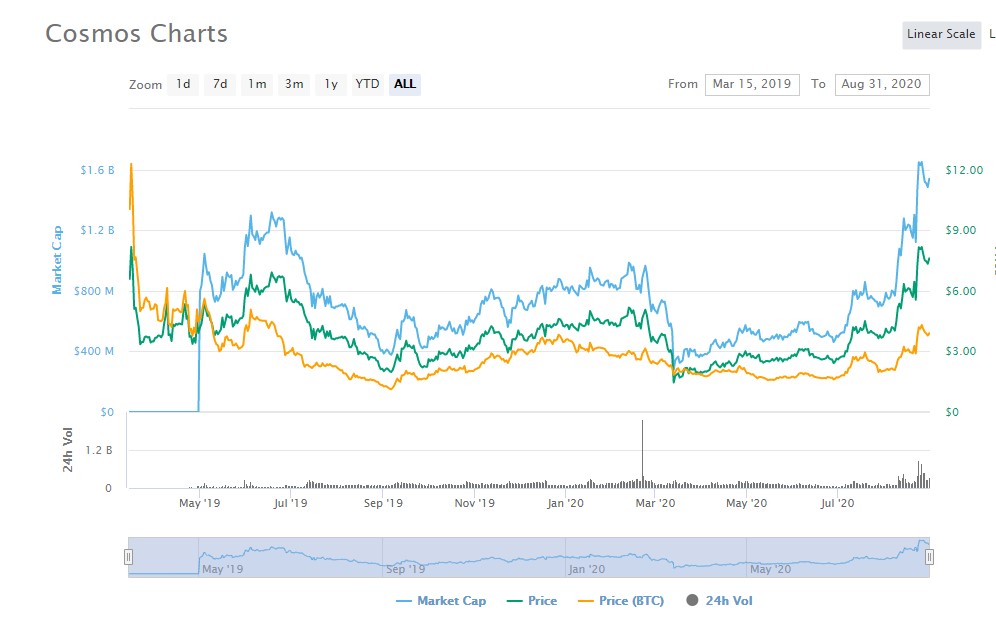
At the start of 2020, Cosmos had a market cap of $802.5 million and an average market price of $4.3. At the time of writing (August 31 2020), it’s now ranked 19th with a market cap of about $1.18 billion, a market price of $5.7, and a 24-hour trading volume of about $321 million. That’s a 47% growth in market cap and a 32.6% increase in market price over 8 months.

  • Core Area of Usefulness

Cosmos partners with OmiseGo, IRIS, Loom Network, FOAM, Theta Toe, etc. to provide solutions to blockchain scalability, sovereignty and complexity.


  • What to Expect

Cosmos has an average market cap of about $1.2 billion, and a surge is expected in the nearest future. Based on trends, crypto enthusiasts can expect Cosmos attain a market price of $10 by December 2020.                                                                                                                                                                                                                                                                                          

VeChain

VeChain is a blockchain-based crypto platform specifically designed to enhance business models and supply chain management with the aid of DLT. It aims to champion a distributed and trusted business ecosystem that ensures greater transparency in the flow of information, an ultra-swift transfer of value and efficient business collaborations. This project has numerous practical examples and is highly appreciated and recognised by Deloitte, BMW, PICC, PwC, H&M and lots more.

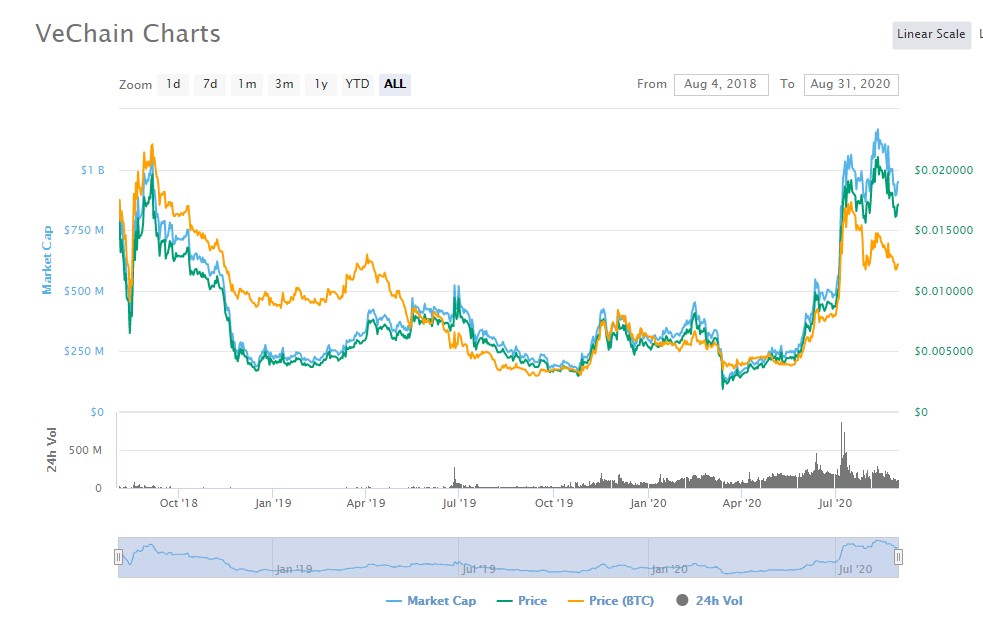
At the turn of the year 2020, VeChain was ranked 30th with a market cap of about $332.4 million and traded at $0.005643. Fast forward to today, it ranks 21st with a market cap of over $1.1 billion, and trading at an average $0.018553. That’s a bullish 258% growth in market cap and 228% surge in market price.

  • Core Area of Usefulness
  • Automobile data tamper-proof – Renault and BMW are currently partnering with VeChain. Data such as driver’s habit, repair history, registration, and insurance are made immutable.
  • Product Anti-duplication: this is executed with the aid of smart chips which ensures that products are not adulterated. Certain luxury brands have already signed up for this.
  • Cold-chain logistics via IoT sensors that automatically interface with the blockchain.
  • Carbon Credits: carbon emission tracking and rewards schemes for friends of the earth.
  • Provide solutions to the traceability of digitalized clinical trials.
  • What to Expect

The surge in the market activity and demand for VeChain is driven by its integration of IoT into supply chain management models. According to cryptoground, VeChain is expected to attain $2.58 by December 2020, although a little unrealistic.

To attain the $2 mark, VeChain would have to match Bitcoin’s market capitalization – that’s a difficult one. However, a more realistic prediction would peg VeChain at about $1 by the end of the year.

Chainlink 

Just like the two cryptos mentioned earlier, Chainlink is also doing exploits, and it has achieved new market prices multiple times already in 2020 – its token is LINK.  A Chainlink solution, Oracles, make it possible to aggregate real-world data, payments and events into the blockchain as smart contracts. Plus, this project finds application on DeFi platforms and is gradually making waves in the pharma space.

  • Historical Performance

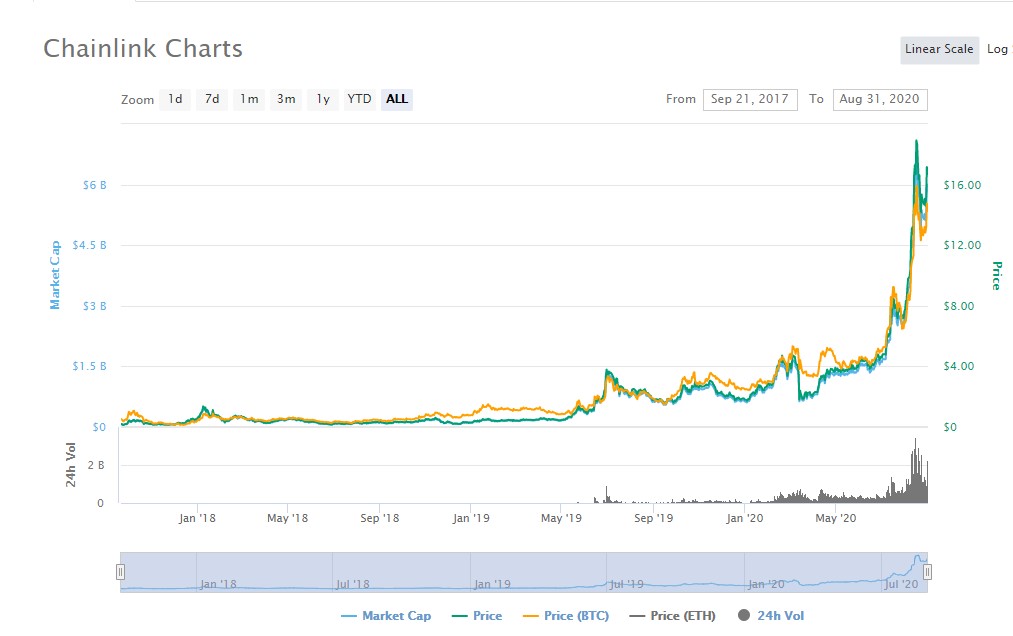
As the time of writing, Chainlink is ranked 5th with a market cap of over $6 billion, and a 24-hour trading volume of over $1.8 billion, according to coingecko. Chainlink started at $1.8 in January 2020, with a market cap of $642 million, but today, it’s trading at $16.7 – that’s a bullish 828% rise in market price.

  • Core Area of Usefulness
  • Retrieval and verification of external data on smart contracts and blockchain network.
  • Decentralized Finance (DeFi) platforms
  • What to Expect

Price predictions are becoming a bit more difficult, especially with the look of the financial market. This might be different for Chainlink as it’s already outperformed several predictions this year on many occasions, and is currently trading above the $5-10 mark forecast.

According to an AI-enabled algorithm from Crypto-Rating, Chainlink is predicted to trade at about $20 by the end of 2020, towards the turn of 2021. This is pretty much realistic and it an only get better with this project.

Recommended: As The Crypto Spring Becomes Evident,Here Are The Top 3 DeFi Leaders In H2 2020

Disclaimer: This is clearly the opinion of the author and not a piece of financial advice. Endeavour to dig deep before you make any investment in cryptocurrencies.