XRP recently recorded a favorable court ruling against the U.S. Securities and Exchange Commission (SEC). This decision was highly anticipated by many in the crypto community as it could have major implications for how digital assets are regulated in America going forward.
The issue at stake is whether XRP should be classified as a security under U.S law, which would require it to comply with federal securities regulations like other stocks and bonds do.
The SEC harped on the sales of billions of tokens to investors over several years by XRP to investors, thereby contravening the securities’ act. On its part Ripple maintained that since XRP has been used primarily for payments rather than investments then it should not be subject to SEC regulation as a security but instead treated more like currency or commodities such as gold and oil.
Ultimately Judge Sarah Netburn ruled in favor of Ripple stating that “there is no reason why [XRPs] economic reality must align with [the SECs] definition” thus allowing them some breathing room from strict regulatory oversight while still being able to operate legally within US borders.
While this ruling may seem small now, it could potentially set precedent for future cases involving cryptocurrencies across America if similar decisions are made down the line by other courts when faced with similar questions regarding asset classification.
Who is Judge Netburn?
Judge Sarah Netburn is a United States District Judge who was assigned to preside over the ongoing Securities and Exchange Commission (SEC) vs Ripple (XRP) case. Her role is to oversee the legal proceedings and make a final judgment based on the evidence presented by both parties.
SEC’s Case Against Ripple XRP
In the ongoing XRP case, the SEC (U.S. Securities and Exchange Commission) has accused Ripple, the company behind XRP, of conducting an unregistered securities offering worth $1.3 billion. The SEC alleges that Ripple’s sale of XRP tokens constitutes an investment contract and therefore should have been registered with the agency.
The SEC also claims that Ripple’s executives, including CEO Brad Garlinghouse and co-founder Chris Larsen, personally profited from the sale of XRP. Ripple has denied the allegations and argues that XRP is a currency rather than a security. The case is currently being heard in court, with Judge Sarah Netburn presiding over the proceedings.
How Ripple Defended its Stance
Ripple’s defense in the XRP case is that XRP is not a security but rather a currency or digital asset. Ripple argues that XRP is not an investment contract and therefore not subject to the same regulations as securities.
Ripple also claims that the SEC did not provide clear guidance on the status of XRP as a security for many years, leading to confusion in the market. Additionally, Ripple claims that the SEC’s actions have caused harm to XRP holders and the market. The trial Judge has ruled in favor of XRP and SEC has now moved on to appeal the case.
XRP price leapt by 80 percent in the wake of the recent court case against it by SEC. With the case outcome considered to be favorable by the market, the crypto looks set for a new high. Whether this will be sustained, is a different ballgame altogether.
Factors that can drive a rice rally includes the following:
Market Sentiment: Positive news, developments, partnerships, or regulatory clarity can significantly influence market sentiment, leading to increased demand for a cryptocurrency.
Adoption and Use Cases: Increased adoption and real-world use cases can boost the value of a cryptocurrency. If XRP gains traction as a preferred means of cross-border payments and other financial services, its price could rise.
Technological Developments: Advances in the technology behind a cryptocurrency can enhance its utility and security, attracting more investors and users.
Market Speculation: Speculative trading can lead to rapid price increases. Traders looking to profit from short-term price movements can create volatility in the market.
Macroeconomic Factors: Economic events, such as inflation concerns, currency devaluation, or geopolitical tensions, can drive investors toward cryptocurrencies as alternative assets.
Impact of Price Rallies
The effect of a price rally on the prospects of a cryptocurrency like XRP depends on various factors:
Positive Effects: A price rally can attract more attention, new investors, and increased adoption. It can also validate the utility of the cryptocurrency’s technology and use cases.
Negative Effects: Rapid price increases can also lead to concerns about market manipulation, excessive speculation, and a potential bubble. If the rally is not supported by fundamental improvements in technology and adoption, it could lead to a sharp price correction.
Regulatory Impact: Some price rallies might prompt regulatory scrutiny, especially if the rally appears disconnected from the actual utility of the cryptocurrency. Regulatory actions could impact the cryptocurrency’s prospects.
Long-Term Viability: For sustainable growth, a cryptocurrency’s price should ideally be supported by its real-world use cases, technological advancements, and a strong community. Price volatility without underlying substance could hinder long-term prospects.
TAKEWAYS
Keep in mind that the cryptocurrency market is highly speculative and can be influenced by a wide range of factors. To understand the specific factors leading the new XRP price rally and its potential implications, it’s best to refer to the most current and credible sources of information, as a series of events are still unfolding.
Stablecoins are a type of cryptocurrency that are designed to maintain a stable value relative to another asset, such as a fiat currency like the US dollar or a commodity like gold.
There are several types of stablecoins, including those that are backed by reserves of the underlying asset, those that are backed by a basket of assets, and those that use algorithms to maintain a stable value.
The Argument for Stablecoins
The primary reason for the development of stablecoins is to address the issue of volatility that is inherent in many cryptocurrencies. Unlike fiat currencies, which are backed by a central government and maintain a relatively stable value, cryptocurrencies are decentralized and subject to market forces that can cause their values to fluctuate rapidly.
Stablecoins are designed to provide the benefits of cryptocurrencies, such as fast and cheap cross-border transactions and increased privacy, while also addressing the issue of volatility. They achieve this by pegging their value to another asset, such as a fiat currency or a commodity like gold, thereby maintaining a stable value relative to that asset.
Stablecoins can be particularly useful for individuals and businesses looking to transact in cryptocurrencies but who are concerned about the volatility of other cryptocurrencies. If a business wants to accept cryptocurrency payments but doesn’t want to be exposed to the risk of a sudden drop in value, they could choose to accept payments in a stablecoin with a fiat currency peg.
Stablecoins can also be useful for individuals in countries with unstable currencies who are looking for a more stable store of value. By using stablecoins, these individuals can protect themselves against the inflation and currency fluctuations that can occur in their local currency. It is important to note the following:
-Overall, stablecoins provide a way for individuals and businesses to transact in cryptocurrencies while minimizing the risk of volatility
-Stablecoins have gained popularity in recent years, as they provide a way for cryptocurrency users to hedge against the volatility of other cryptocurrencies.
-They also offer a way for individuals and businesses to transact in cryptocurrencies without being exposed to the same level of risk.
Regulatory actions can potentially pose a threat to stablecoins, as they may create uncertainty and reduce the level of trust in these cryptocurrencies. Stablecoins, like other cryptocurrencies, exist in a relatively unregulated space, which can make them vulnerable to regulatory action by governments and financial institutions. Also, the risk of nefarious usage still looms large.
Governments and financial institutions may therefore seek to regulate stablecoins to prevent these types of activities. For example, they may require stablecoin issuers to comply with anti-money laundering (AML) and know-your-customer (KYC) regulations, or they may restrict the use of stablecoins in certain jurisdictions.
Notably, stablecoins that are pegged to a fiat currency may be subject to regulations governing the issuance and exchange of that currency. This could potentially limit the ability of stablecoin issuers to operate in certain jurisdictions or restrict the types of assets that can be used to back the stablecoin.
However, it is important to note that regulatory actions may not necessarily be a threat to stablecoins in the long term. In fact, some level of regulation may increase trust and adoption of stablecoins by providing a clear legal framework and reducing the risk of fraudulent activities.
Moreover, some stablecoin issuers have already taken steps to comply with AML/KYC regulations and other regulatory requirements to operate in a compliant manner.
In terms of their future, it is likely that stablecoins will continue to play a significant role in the cryptocurrency market. As the adoption of cryptocurrencies grows, there will be an increasing demand for stablecoins as a means of transacting in a stable currency.
Stablecoins offer several advantages over traditional fiat currencies, such as faster settlement times and lower transaction fees. This could make them an attractive option for businesses and individuals looking to transact across borders or in regions with unstable currencies.
The regulatory landscape surrounding stablecoins is still developing, and there are concerns around the potential for stablecoins to be used for money laundering and other illicit activities. It remains to be seen how regulators will address these concerns and what impact this will have on the future of stablecoins.
In summary, regulatory actions may pose a short-term threat to stablecoins, but in the long term, they may help to increase the level of trust and adoption of these cryptocurrencies.
Cryptocurrency markets and stock markets have many similarities, which can make it difficult to differentiate between them. Both involve trading of assets, both require a certain level of risk management, and both are subject to market volatility. However, there are some key differences that set cryptocurrency markets apart from traditional stock exchanges.
Cryptocurrency markets and stock markets have identifiable similarities that are worth considering. Both are financial instruments used to invest in the future growth of an asset or company, both involve buying and selling different assets, and both carry some form of risk for investors.
While there are many differences between cryptocurrency markets and stock markets, it is important to understand the commonalities that exist between them as well.
The most obvious similarity between cryptocurrency markets and stock exchanges is that they provide investors with a platform to buy or sell digital assets such as coins or stocks respectively. This means that irrespective of whether you’re investing in Bitcoin on Coinbase Pro or Apple shares on Nasdaq, you’ll still be engaging in similar activities such as:
researching potential investments before committing capital into them
Monitoring prices throughout their life cycle
Understanding how market conditions affect your holdings.
Researching trading strategies related to entry/exit points, among others.
The web of activities above requires implies having access to tools like charts & graphs which allow traders/investors alike always keep track of their positions, this also plays in enabling informed decision making when needed (such as taking profits).
Market Volatility
Another key similarity worth mentioning here relates directly towards volatility found within these two types of financial instruments – crypto assets & equities alike. Both asset classes experience drastic price changes over short periods due primarily because they lack liquidity compared with other more traditional forms investment vehicles (like bonds).
The uniqueness of these assets makes it paramount for any investor seeking exposure via either avenue to know about their attendant risks. Exactly what kind of risks that each one entails must be grasped for appropriate precautions to be taken so as to mitigate losses where possible.
The point here is that diversification across multiple cryptocurrencies or stocks can be helpful. Utilizing stop loss orders ensure funds aren’t wiped out -single bad trade gone wrong!
Overall, Cryptocurrency Markets & Stock Exchanges share pointed characteristics from basic operations right up sophisticated trading techniques.
While there is no doubt there will always remain certain distinctions separate them apart from one another given unique nature each respective industry – yet knowing similarities present allows savvy individuals make best use opportunities available whichever side fence decide stand upon!
Market Predictions
The most obvious similarity is the fact that investors in both types of financial instruments buy and sell assets for profit or loss depending on their predictions about future price movements. As with any type of investment vehicle though, traders must be aware of the risks associated with each asset class before investing capital into either one.
In addition to the above commonality between crypto-assets and stocks, it is their susceptibility to market volatility that sometimes led to fails in market predictions. The truth is that prices can move quickly in either direction due to news events or other factors beyond an investor’s control. Both markets have this pitfall, and it also binds them as a similarity.
One major difference between cryptocurrency exchanges (such as Bitcoin) versus traditional stock exchanges lies within their underlying technology. Both markets have different underlying algorithms. Blockchain drives crypto while the stock market uses a range of technologies.
Blockchain technology provides a secure platform upon which all transactions take place while still allowing users anonymity. This is not something that is possible through more established channels such as NASDAQ or NYSE Euronext where personal information must be provided prior conducting trades online.
Moreover, cryptocurrencies offer lower transaction fees compared with what is charged by banks when sending money abroad thus providing an alternative source for international payments.
Lastly, unlike stocks whose performance depends heavily on macroeconomic conditions like GDP growth rates inflation etc., cryptocurrencies show less correlation with global economic trends. This gives long term investors a chance to find value in diversifying portfolios across multiple asset classes including digital currencies.
Last Line
Overall, although cryptocurrency markets share several features like traditional equity investments, there remain distinct advantages offered by digital tokens that should be considered before committing funds any given project.
By understanding nuances separating the two different forms trading-savvy individuals should ably capitalize on glaring opportunities available regardless of the risk element. After all, the big money-makers would say “the greater the risk, the bigger the reward”.
One of the hottest trends in the industry today is the idea of “NFTs”. What is NFT? It is a special kind of token that represents a digital asset or physical item.
For example, a token that represents a digital art piece that you’re selling on the NFT marketplace could be considered an NFT. Non-fungible tokens are an interesting concept because they represent a way of adding utility to something — in this case, art. it then becomes a digital asset and can be sold.
The token’s identifying information is stored in a decentralized registry, in the form of Smart Contracts. These registries, similar to the ones used for decentralized apps, enable developers to digital assets directly to users.
As opposed to cryptocurrencies like Bitcoin where one BTC has the same value as another, non-fungible tokens are all unique in their own right. Furthermore, they are not divisible like fungible tokens. In this guide, we will explore NFT with regards to staking and the mechanics of how it all works.
One of the thoughts that come to mind is the prospect of staking them for additional profits. Let’s start with the basics, and build from there.
What is Staking?
Among many other things a user can do with NFTs is the idea of staking, which allows you to lock up some of your NFT tokens in a proof-of-stake crypto wallet to secure and govern a blockchain network. It is done in exchange for rewards, rather than a simple deposit or withdrawal model. It’s like a spin-off from mining, but not the same thing.
Why Stake NFTs?
The NFT ecosystem is hampered by low liquidity. At present, it is underdeveloped, as most users purchase the tokenised asset for long-term appreciation. Others do so to burn them, which creates scarcity, and, in turn, increases the value. Staking comes into play to resolve this problem. Staking a non-fungible is no different from staking a cryptocurrency.
Once you’ve found, for example, a digital asset with a revenue-generating potential, stake your tokens and receive incentives. The fee and block could come in the form of an annual percentage yield (APY) of the staked token, depending on the lock option duration. It could feature additional network validation, to ensure transaction integrity and confirmation.
Staking rewards depend on a variety of factors. Among them is the NFT asset’s potential to generate considerable income streams. NFT crypto staking can provide rewards up to 100% APY. Besides generating income for users, NFT staking also increases liquidity and attract more investors to the ecosystem. In turn, this will further facilitate the ecosystem’s growth.
Projection of the NFT Ecosystem
At the moment, NFTs encapsulates crypto, gaming, and digital artwork collectibles. However, content creators are currently hopping on the bandwagon, incorporating NFT into their products. For instance, artists who are into oil painting can create a digitized version of their works and even earn royalties.
Notable brands current license their NFTs, including Kellogg’s, Pizza Hut, Ubisoft, MGA Entertainment, and Taco Bell. As of June 2021, Twitter launched its NFT collections. If there’s any better time to become a part of the NFT ecosystem is now!
Conclusion
If you are already an NFT enthusiast who’s short on ideas for how to generate additional income other than HODLing long-term, NFT staking may be the answer. Look for NFTs with the potential to create good returns and invest your money. What makes staking interesting is that you don’t need to purchase your asset of choice outright; yet, you can partly own it and still earn high ROIs.
When it comes to the selling and buying of bitcoin, Nigeria is at the forefront having the highest Google searches for Bitcoin after the US and ranking top in peer-to-peer transactions. If you are interested in joining the current revolution and being well informed on how you can trade Bitcoin safely in Nigeria, please read on.
What is Bitcoin
According to Bitcoin.com, Bitcoin in the practical sense is money that exists in a digital form.
Bitcoin Price Highlights
The price of Bitcoin is the current price at which bitcoin is being traded. It is determined by the buyer and seller. Despite this, its price varies across exchange platforms such as Coinbase and Binance because of market inefficiencies.
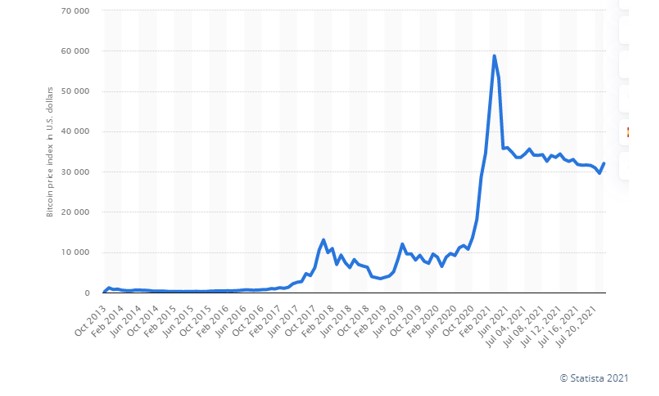
Statista Data Grab
Within the past five years, Bitcoin has witnessed dynamic surges in its value rising to around $1,290 in March 2017, the highest ever it has been before then. This trend continued across the months getting to a peak of $19,783.06 nine months after on December 17, 2017.
Up till the year 2021, the price of Bitcoin continues to increase with surges and minimal decline along the way. On April 10, 2021, Bitcoin recorded its highest ever price to date some months after Elon Musk and Tesla announced their investments in Bitcoin peaking at above $60,000.
Though the value of Bitcoin in the crypto market suffered a crash to half this price in May 2021 due to rumors of Tesla selling its Bitcoin holdings, the price is still on the high side when compared to how it was a year ago.
The Features of Bitcoin
It is Decentralized
The very first and intriguing feature of bitcoin is its decentralization. This simply means that there is no central power or regulator as the case is with traditional currencies which are designed, issued, and managed by a central authority.
Transparent transactions
Bitcoin transactions are visible to everyone in the digital world of cryptocurrency though Individual Bitcoin assets are concealed to promote privacy and confidentiality which motivates positive trading.
Anonymity
It is to be stated here that the identity of users of Bitcoin remains anonymous and the chances of tracking transactions back to Bitcoin users are very minimal. This is to prevent online robbery or digital theft.
Fast transaction
When compared to other modes of transaction such as bank transactions, bitcoin transactions are faster.
Nonrefundable mode of transaction
Bitcoin transactions are a one-way mode of transaction. Any transaction made from a sender to a buyer cannot be reversed unless the buyer is willing to do so.
Digital Currency
Bitcoin is not a physical currency but a digital one. You can never carry a bitcoin in your purse or pockets in the form of notes or coins, but you can easily carry it on your phone or tablet.
Simple to use
Most of the time, to open and manage a bank account is quite tedious and long. This is not the case with a Bitcoin account. You can set up your account in a matter of minutes.
Value is determined by demand
The value or price of Bitcoin is not fixed like other assets. It depends on market dynamics. The value of Bitcoin is determined by the strength and volume of its demand.
How to Buy Bitcoin
If you are interested in buying Bitcoin in Nigeria and ready to explore the untapped benefits in the world of cryptocurrencies, there are different exchange platforms, brokers, and marketplace that can help you. Below is a guide on how you can go about this.
Buying Bitcoin on Binance
Binance is the biggest cryptocurrency trading platform on earth today, recording up to $2.46 trillion in May 2021 transaction volumes. The platform offers the largest trading base for listed crypto and offers the major trading pairs with leads like BTC, ETH, XRP, USDT, DAI, BNB and BUSD on the P2P front.
At present, to buy Bitcoin in Nigeria using the Binance platform will only be possible using the P2P platform it offers. Firstly, you need to register your new account using this process:
·Your driver’s license, international passport or national ID card will be needed
·You also need to link a bank account to your profile to use for the transactions
·You will be notified if your application is successful, and you can start using your new account.
How to buy Bitcoin on Binance P2P Platform
On the platform, log in to to your account, and navigate to the P2P page from your account dashboard.
Locate the the P2P and express tab and click on your preference
With the express tab, the platform matches you with the available sellers on the platform with you deciding
transfer the funds to the seller and wait for at lest 15 minutes
You will have to click on payment made tab to notify the seller
Your BTC will show up on your balance after the seller confirms receipt of payment made.
Buying Bitcoin on the Coinmama Exchange platform
Coinmama as an exchange platform was founded in 2013 with the mission of making simple how Bitcoin (BTC) is traded. The platform has more than 2.9 million users in over 190 countries in the world. It also provides the platform for some users in selected markets to sell their Bitcoin.
How to open an account on Coinmama
Go to the sign-up page to create your account. Fill in your email in the allocated spaces as well as your country of residence to get started.
Thereafter, click on the verification link sent to your email
Verification
Complete the requested form to confirm your identity and safeguard your account.
Thereafter, you will be required to upload an ID to approve you for purchase. Choose the ID type you will like to upload based on your country of residence. Take a photograph of the front and back of your ID with your phone camera with all four corners visible and clear image and text, then upload them to your account.
Then, write “Coinmama” and date on a piece of paper. Hold the paper and the ID you’ve just uploaded and take a photograph of yourself. Ensure your face, ID, and paper note are visible. Then upload the photo to your account.
After successfully uploading, click to submit. Your form and documents will be reviewed by the verification team for verification. If everything is okay, you will be approved to buy Bitcoin online with Coinmama within fifteen minutes.
How to buy
Sign in to your account to buy bitcoin. Select the cryptocurrency (Bitcoin) you want to buy and the currency of your choice
Select the package of your choice and input your desired amount, thereafter you can tap “buy”
Input your selected third party wallet address
A confirmatory link will be sent to your email to confirm your wallet address, click on it if it is correct
After your payment has been approved and the wallet address confirmed, the coins will be immediately delivered to your wallet.
Buying Bitcoin on the Luno Exchange platform
Luno has been in the cryptocurrency industry since 2013 with transactions worth more than 14 million dollars. The platform has customers in over 40 countries.
First, you need to go to the sign-up page to create your account. Similar to that of Coinmama
Verification
Complete the requested form by filling in your first name, middle name, gender, date of birth, phone number address, city, and zip code. You can also click on the ‘I’ve confirmed my email’ option in the Luno app. After which you will be automatically verified with the submitted phone number and personal details.
If not, you will be required to upload a document for verification (driving license, identity card, or passport). Open the Luno app and sign in, tap Profile on the Menu, navigate to Settings, select Upgrade. The document is required to show your identity number, name, date of birth, and a clear photo.
You may also need to confirm your address. To get this done, you will upload a photo or an ID which contains your name, address, residency, and issue date. This ID must not be older than 3 months.
How to deposit
Open the Luno app and sign in
Select Wallets from the menu
Choose your local currency wallet
Select Deposit
Choose the method with which you’d like to top-up your wallet
And follow the on-screen prompts from there
How to buy
Verify your identity on Luno.
Deposit to your local currency wallet, once it reflects in your wallet, then you can proceed to buy.
Thereafter, you can simply tap the specified amount on the homepage screen to buy or specify the amount of your choice. Then pay or make use of Luno Exchange.
Buying Bitcoin on Coinbase
Almost all users begin their crypto journey through Coinbase. The platform has been in the cryptocurrency industry since 2012 with quarterly trade worth more than 335 billion dollars. The platform has more than 56 million verified users, 8,000 institutions, and 134,000 ecosystem partners in over 100 countries.
How to buy on Coin base
Sign in to Coinbase. Account creation and verification quite like Coinmama
Choose either Buy / Sell on the upper right-hand side.
Select the Buy field to choose the asset you’d like to purchase.
Specify the amount you’d like to buy either in crypto or your local currency.
Choose your payment method.
Click Preview Buy to verify your purchase (you can always click the back arrow to make a change).
If your details are correct, click Buy to complete your purchase.
Buying Bitcoin on eToro
eToro is a social trading network founded in 2007. It is among brokers hosted on trusted brokers.ng. You need to register an account on the platform to buy bitcoin.
Opening an account involves:
Uploading a valid ID (ID Card or Passport) and a proof of address (electricity, water bills, etc.), through eToro’s platform. Approval takes less than a day.
To buy Bitcoin on eToro:
Select a bitcoin exchange or trading platform, in this case, the eToro trading platform
Ensure your account is verified
Deposit through your preferred deposit method and buy bitcoin fractionally.
Buying Bitcoin on plus 500
Plus 500 is a trading platform founded in 2008 which allows for the trading of cryptocurrencies among other commodities such as Forex and ETFs.
It is among the brokers hosted on trustedbrokers.ng. Though it is one of the main trading platforms in the United Kingdom, it is not open to customers from Nigeria.
Buying Bitcoin on marketplaces such as Localbitcoin
LocalBitcoins is an escrow service that serves as a crypto marketplace helping to match bitcoin buyers and sellers. Users are free to advertise trades for any payment method they choose. Below are five steps you can follow to buy bitcoin:
After registration, go to the main page, and search for offers.
Step 3: Select an advertisement
From the list shown, select offers.
Step 4: Pay the seller
Evaluate the offer and pay
Step 5: Mark payment complete
Click the paid button and the transaction will reflect in the wallet
How to store Bitcoin
In the same way money or cards are stored in a purse or handbag containing a wallet, bitcoins are also stored on the phone or computer desktop hosting a digital wallet whether web-based or on hardware.
Bitcoin Price Outlook
Though Bitcoin has struggled over the past few months, even falling by more than half in April 2021, many analysts that bitcoin may overtake the U.S dollar as the dominant form of global finance by the year 2050 which puts the price of Bitcoin at above $66,000 by the end of 2021.




 Harrison Global Capital