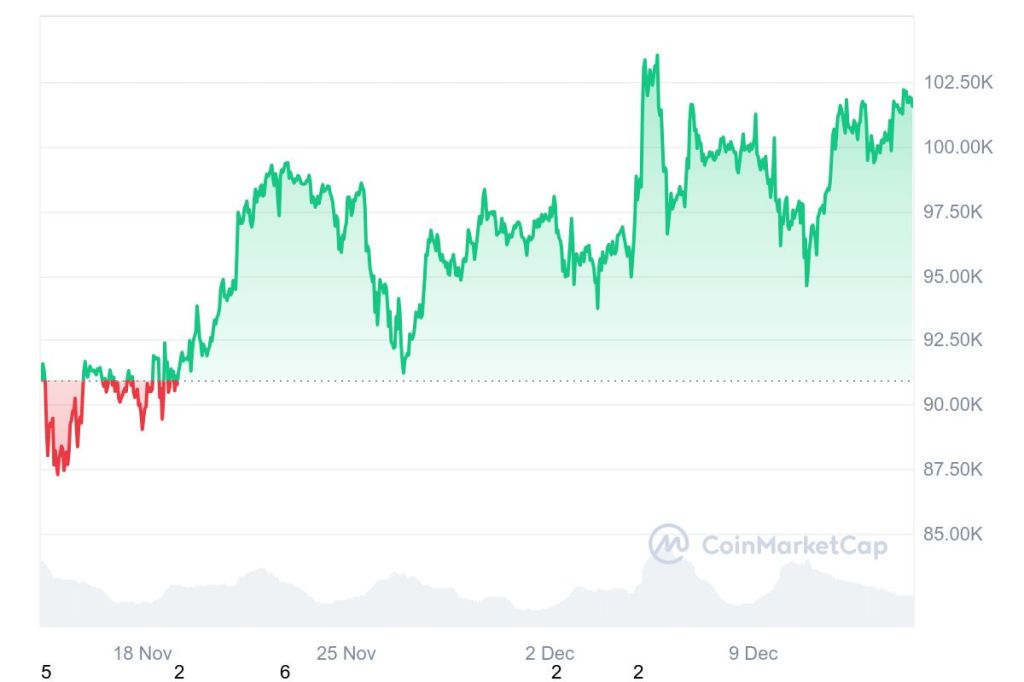
In December 2024, Bitcoin surpassed $100,000 for the first time, driven by strong demand and investor enthusiasm following the U.S. presidential election. Institutional investments and macroeconomic factors, such as concerns about inflation, further fueled this surge. The milestone signals Bitcoin’s growing legitimacy as an asset class and its potential impact on the future of finance.
Bitcoin, the pioneering cryptocurrency, has made headlines once again by surpassing the $100,000 mark for the first time in its history. This milestone, reached in December 2024, marks a significant moment not only for Bitcoin but for the entire cryptocurrency market.
Understanding how Bitcoin achieved this remarkable feat involves examining various factors, including market dynamics, investor sentiment, and broader economic influences.
The Surge to $100,000
The journey to Bitcoin’s $100,000 price point was characterized by a rapid increase in demand and a series of events that fueled investor enthusiasm. One of the most notable catalysts for this surge was the U.S. presidential election, which saw Donald Trump emerge victorious.
DT’s victory sparked a wave of optimism among investors, leading to a significant influx of capital into the cryptocurrency market. In the weeks following the election, Bitcoin’s price soared by more than 30%, reflecting a broader trend of increased interest in digital assets
The excitement surrounding Bitcoin was not merely a reaction to political events; it was also driven by a growing recognition of Bitcoin as a legitimate asset class.
Over the years, Bitcoin has transitioned from being viewed as a speculative investment to being considered a store of value, akin to gold. This shift in perception has attracted institutional investors, who have begun to allocate a portion of their portfolios to cryptocurrencies, further driving up demand.
As Bitcoin approached the $100,000 milestone, market dynamics played a crucial role in its price movement. The cryptocurrency market is known for its volatility, and Bitcoin’s price history has been marked by significant spikes and corrections. However, the prevailing sentiment during this period was overwhelmingly bullish. Many investors believed that Bitcoin was on the verge of a breakout, leading to a self-fulfilling prophecy where increased buying pressure pushed the price higher
The psychological aspect of reaching a round number like $100,000 cannot be understated. Such milestones often serve as psychological barriers that traders and investors watch closely.
When Bitcoin finally broke through this level on 5 December 2024, it created a sense of euphoria in the market, encouraging even more buying activity. This phenomenon is common in financial markets, where traders react to significant price levels, often leading to further price increases.
The Role of Institutional Investment
Another critical factor in Bitcoin’s ascent to $100,000 was the increased participation of institutional investors. Over the past few years, major financial institutions and corporations have begun to recognize the potential of Bitcoin as a hedge against inflation and a means of diversifying their investment portfolios.
Companies like MicroStrategy and Tesla have made headlines for their substantial Bitcoin purchases, signaling a shift in how traditional finance views cryptocurrencies.This institutional interest has not only provided a significant boost to Bitcoin’s price but has also contributed to its legitimacy as an asset class.
As more institutions enter the market, they bring with them a level of stability and credibility that can help mitigate some of the volatility traditionally associated with cryptocurrencies. This influx of institutional capital has been a game-changer, allowing Bitcoin to reach new heights.
Global Economic Factors
The broader economic environment also played a significant role in Bitcoin’s price surge. In the wake of the COVID-19 pandemic, many governments around the world implemented aggressive monetary policies, including low interest rates and quantitative easing.
These measures have led to concerns about inflation and currency devaluation, prompting investors to seek alternative assets like Bitcoin.As traditional fiat currencies face uncertainty, Bitcoin has emerged as a potential safe haven.
Bitcoin’s limited supply—capped at 21 million coins—makes it an attractive option for those looking to preserve wealth in an inflationary environment. This narrative has resonated with a growing number of investors, further driving demand and contributing to the price increase.
Conclusion
Bitcoin’s journey past the $100,000 mark is a testament to the evolving landscape of finance and investment. The combination of political events, changing investor sentiment, institutional participation, and global economic factors has created a perfect storm for Bitcoin’s price surge.
As the cryptocurrency continues to gain traction and acceptance, it will be fascinating to see how it evolves and what new milestones it may achieve in the future.In summary, Bitcoin’s rise to $100,000 is not just a reflection of market speculation; it represents a significant shift in how investors view cryptocurrencies.
With increasing legitimacy and a growing base of support, Bitcoin is poised to play a crucial role in the future of finance.
Golem blokchchain provides a better insight into cross-chain capabilities that can truly make a difference in our world.
The Golem Project Homepage
From the beginning, one of the main features of blockchain technology has been the capacity to use both the idle and active processing power of a blockchain’s nodes to create distributed supercomputers.
This power, which would make the likes of folding@home or seti@home seem primitive, has sadly not been fully used so far – with the vast majority of a blockchain’s processing power sadly going to meaningless “mining” activities that provide no service whatsoever other than wasted power and processing.
Over the last couple of years, however, several new projects have tried to take advantage of this, turning what used to be “mining” duties into essentially loaning your PC’s computing power in exchange for crypto. Golem is, as you probably expected, one of these.
Most blockchains in today’s world award cryptocurrencies in exchange for processing power. However, the processing power in most blockchains goes for transaction authentication and, for older blockchains, mining.
The mining process is perhaps the most famous blockchain-related activity – it’s been repeatedly hailed as the way many crypto millionaires became millionaires to begin with. While the profitability of this task these days can be argued against, it’s still a relatively common activity, and one that uses huge amounts of processing power.
One would think this processing power would be used for huge, difficult tasks the blockchain requires. And one would be partly right – it is indeed used for huge, difficult tasks, that aren’t at all necessary. Mining basically consists of brute-forcing a complex mathematical problem in order to determine who’ll get the crypto. Said problem isn’t at all relevant, and essentially all that processing power goes to waste.
The actual amount of processing power spent in order to authenticate transactions is, in fact, very small. Small enough that most current-day blockchains have migrated to a staking model – which doesn’t require large amounts of processing power and you can technically do from your phone.
So Golem sells processing power… How? And to whom?
Let’s start with the basics: Yes, they sell processing power. Your processing power. And they pay you for it with their own cryptocurrency.
The “how” part is much more complex, but it can be resumed in a phrase by saying the Golem blockchain is a massive, distributed supercomputer made up of every single node connected to it. Yes, that can be difficult to understand, but no, there aren’t many simpler ways of saying it.
Let’s think of every leaf from a tree as a computer. Your computer is just a leaf, one that’s potent enough for what you need. The Golem blockchain? The Golem blockchain is the tree connecting all the leaves. In fact, the Golem blockchain could be even bigger – an orchard.
The whole point is, Golem would connect all the leaves in a tree (ie, the computers of those lending their power) so that they all together can work on a much larger task.
As for who is the customer? Well, not you or I. That’s for sure.
Most people obviously don’t need a supercomputer. We have more than enough with our pcs, or laptops, or phones. However, there are tasks that go well beyond what any single computer can do.
Large simulation tasks, for example, are extremely tasking and can eat up all available resources even in workstations specially built for it. The same goes for large rendering tasks for architecture or video projects. Some security systems can even be quite processing hungry – plus being distributed can help in those tasks.
The companies working in those areas are the customers. Maybe some projects are too big and they need a boost. Maybe they want to get something done faster than their hardware would allow. Maybe they’re just getting started, and hiring processing power is cheaper than buying a workstation, at least while the company finds its footing.
It doesn’t matter. The point is: There are customers out there who would love to pay for your processing power. Golem makes that a possibility.
How is Golem different from other blockchains that trade processing power?
There aren’t that many blockchains trading in processing power to begin with. Even then, the most common proposals for processing power trades using blockchain relate to inter-blockchain transactions and allowing users to exchange their cryptocurrency for another one without having to go through a middleman.
Other than that, most companies selling processing power do so on their own, without blockchains, and without getting you involved. In that regard, Golem is unique.
Will Golem change the blockchain world?
That’s still to be seen. It could be a great addition to the blockchain world – in fact, soon enough we might even see webservices that rely entirely, or almost entirely, on the Golem network, leading us closer to distributed internet.
The project might also fizzle, as many do.
The important part with Golem is that the project offers something new and not niche. Processing power is a commodity these days many companies need. There’s a client base out there for it. Making money out of our processing power is also something people like, as the millions of people mining cryptocurrencies show.
In Golem’s market, then, there’s both offer and demand. Golem is just trying to connect them together. This project is not creating a new market, just facilitating an existing one. Since the market is already there, then, Golem’s chances of success are quite good.
The news made ripple as you would often expect in the crypto world whenever any mid to large-size established company jumps in.
TD Ameritrade started a formal crypto division. While the move was somewhat expected, since it had already invested in crypto exchanges, the news still left many people wondering: what does this mean?
What is TD Ameritrade?
In order to know
whether this move matters or not, we first need to know the company we’re
talking about.
TD Ameritrade is a long-established American broker. With almost fifty years in the market, its mission is to help customers both buy and sell all kinds of stocks, funds, and futures.
In other words, Ameritrade is a very large stock trading house, one with established success in the business.
While this might look as just another financial company trying to break into crypto, the type of company matters a lot this time around.
As we have mentioned in many of our articles, the crypto world is a lot like the stock market. Crypto exchanges, and many crypto investors, work in more or less the same way stock traders do.
So when a company renowned for stock trading options joins in, it can’t but be important. The fact that such a company is jumping into cryptocurrencies means two things:
Its managers see a future to cryptocurrencies,
and
They feel the market has settled and is stable
enough that they can start offering their expertise without risking much.
Both of these
things are huge, since many traditional economy-related businesses have shunned
crypto, and at times even outright tried to sabotage it.
But TD Ameritrade trades in
many things, doesn’t it?
Yes.
TD Ameritrade works both as an exchange of sorts and as an investments company. Its goals aren’t just to commercialize stocks and values, but to help those looking to invest find the right things to invest in.
To attain this, it offers customers several both premade and customized portfolios containing mixtures of stocks, funds, futures, and now crypto its team of experts consider good investments.
The advantage of these services are huge for clients who don’t know the stock market inside out. With Ameritrade’s guidance, they can choose where to put their money following the advice of leading experts in the market.
This helps minimize, although not eliminate, the risk involved in investments.
TD Ameritrade also offers many specialty plans dealing with managing both one’s own finances and one’s economic future. Customers get help not only investing, but also managing their properties and assets. TD Ameritrade thus seeks to help its customers optimize their own portfolios.
For more knowledgeable customers, it also offers personalized portfolios where they can choose exactly what to invest, although always while receiving advice from professionals in the area.
How important is this for crypto? Is it important at all?
In a way, it’s
huge.
One of the main problems with cryptocurrencies is driving adoption. Many people who have thought of investing in crypto have found the whole blockchain-related environment much too confusing.
Even people who are used to trading in the stock market can feel taken aback when talking about private wallets, public wallets, wallet keys, nodes, mining, and so on.
With this move, TD Ameritrade is allowing its customers to invest in cryptocurrencies without needing to know all this.
It’s also offering professional guidance in the process, both to minimize the risk any newcomers face and to help them understand how the crypto world moves.
What this means for the crypto world is that as of now millions of accounts managed by Ameritrade can jump into cryptocurrency investments.
This doesn’t mean that many people will, or that they will even display any interest in it, but that they have the option to.
In other words, there’s now a simple way for people not in the know to invest in cryptocurrencies.
So is this a game changer? Is
mass crypto adoption about to happen?
Let’s slow down.
TD Ameritrade
entering the market is big, yes. But not necessarily as big as to drive mass
adoption on its own. This is but another step towards that goal, but there’s
still a long way to go.
First, because
we don’t know how many of TD Ameritrade’s customers will actually invest in
crypto. For all we know, Ameritrade might roll out this platform only to have
it fail to attract any relevant interest and become just another offering with
relatively low adoption rates.
Sure, the
opposite might happen. It’s always possible Ameritrade’s customers will be
thrilled to hear they can now invest in crypto and rush to their services,
causing the beginning of a new crypto rush that drives all prices up and leads
to a golden age of cryptocurrency.
But being honest, that’s very unlikely. However, TD Ameritrade’s VP has stated his company’s customer base is very interested in crypto investments.
Whether this is true or just a comment to hype up the crowd and help drive adoptions we can’t know, although it does mean the firm is expecting their new program to do well.
So, to be honest, we should keep our expectations tempered about this. It’s a big thing simply because it marks a new household-level investment company joining the crypto world.
This means trust in the market is growing, which at the same time means we’re one step closer to mass adoption. It also will help drive more crypto adoption, but you shouldn’t expect it to cause a rush.
Can I buy any crypto I want
with TD Ameritrade?
No, you can’t.
TD Ameritrade, and most brokers, will only trade in select stocks considered by their experts to have relatively low risk.
While it does have high-risk offers, they’re usually offered only to clients who specifically look for them, and even then, they tend to come from already curated lists that ensure a certain degree of predictability.
This is because Ameritrade, as any brokers do, wants its customers to have some success in their investments.
It doesn’t look good for a broker to have many clients who end up losing their investments, particularly if they count the elderly among their main demographics.
So even when offering “risky” investments, TD Ameritrade will want to limit the risk.
The crypto
market, as we know, isn’t particularly stable. Any crypto investments offered
by Ameritrade will be considered high-risk right away, due to the
unpredictability of the market. Allowing customers to invest in about any coins
will only make it worse.
That’s a ridiculous number, and making customers browse through such a list trying to understand what each of them is and get a grasp of the risk involved wouldn’t be an option for any brokers.
Also, the vast majority of those cryptocurrencies would make for really awful investments nobody would ever recommend even to their worst enemies.
In the spirit of
making it easier for their users to understand what they’re getting and to
avoid them going bankrupt, TD Ameritrade is for now only
offering Bitcoin and Litecoin.
Is there any logic behind these
choices?
Yes, although it
might not be the kind of logic most crypto users would follow.
Bitcoin is there mostly because it’s easily recognizable. Also, because it’s been relatively stable over the past year, with a tendency to rise the last couple months. But most of all, people know about it.
General media often uses “bitcoin” to mean cryptocurrencies in general, and while most people might not know what Ethereum or Ripple are, they do have a grasp of what Bitcoin is. After all, it was all over the news just a year and a half ago.
Bitcoin is
indeed unstable, outdated, slow, and it will never become the crypto for
widespread use. We know that. But many of the people looking into crypto will
go straight for Bitcoin, because that thing was once worth almost $20,000 each.
Also, Ameritrade is offering crypto as an investment solution, meaning users getting it through them will mostly be parking it.
They won’t buy and sell stuff with it, since that’s not the goal its customers are after. Since Bitcoin is well-known and has kept a stable price with a tendency to rise this past year, it’s an easy choice.
As for Litecoin, it has been on the market for long, has a decent price record, and once again has been rising this last year.
Being a fork of bitcoin, it also isn’t likely to ever attain mainstream use. But once again, this is investment. These people will see it as a value, not a proper currency.
The fact that
Bitcoin’s value is mostly based in expectations and isn’t actually tied to
anything other than public perception doesn’t matter either. As long as its
value keeps going up, people will want to invest in it.
Will this affect the market?
It sure does.
Part of Bitcoin’s rise over the past two months can be attributed to this, among other things. BTC is currently experiencing a bit of a renaissance thanks to several projects being launched around it.
The fact that the crypto market is quickly growing into maturity and BTC’s price is basically an indicator for public trust in crypto also helps.
Should we expect this rise to
continue?
We can’t tell. There are currently actors predicting another BTC rise, along with a rush to $50,000, but the last time such a thing was predicted it was quickly followed with a crash once the bubble burst.
Since bitcoin’s nature is that of a bubble, it’s better to remain wary of any extremely positive predictions.
It might even not be in the crypto world’s best interests to have Bitcoin grow too much, in fact. BTC is known for being outdated, and the sooner another, newer crypto takes over the market the better.
BTC reaching a ridiculously high price will make this very, very difficult – which would in turn make widespread use and adoption of crypto about as difficult.
On the other hand, BTC creating another bubble and bursting would be even worse. Crypto already had a terrible 2018, and it’s only now recovering and making it to the news again.
Another quick price drop would erode public trust in crypto in general, which would greatly slow down general adoption for crypto.
The best we can expect is for BTC to keep rising… a bit. And then stabilizing. A stable market is a requirement for widespread adoption and use.
People can’t trade using a coin that’s constantly changing its value, after all. BTC stabilizing would help bring stability to the market as a whole, which might lead a few high-profile companies to start accepting some cryptocurrencies for payments.
If enough of these companies do so, we’ll start seeing widespread use of crypto.
Adolph Obasogie is a Partner at Harrison Global Capital. Get firsthand info from help@harrisonglobalcapital.com
IEOs have emerged as the successor to ICOs in a number of ways. What are the areas of difference if any?
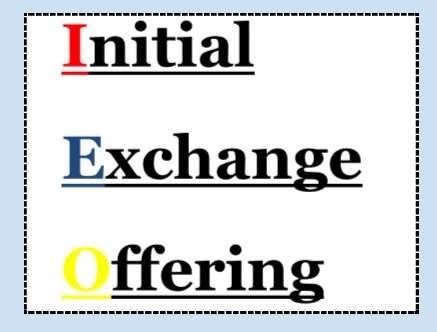
What Is an Initial Exchange Offering (IEO)? Is It the New ICO?
The Initial Exchange Offering(IEO) has been making headlines while catching the attention of investors, traders, exchanges, and project teams following Bitcoin value decline and the ICO fad cool off in 2018.
In 2019, already 32 of the 47 IEOs listed on ICObench have launched while the completed IEOs having raised over $159 million.
Currently, some of the best cryptocurrency exchanges platforms such as Binance, OKEx, Bitmax, Huobi, KuCoin, and Bittrex have already conducted their own IEOs.
And after launching, the majority of these IEO’s have shown much promise after being listed on the exchanges.
What Is an Initial Exchange Offering (IEO)
An initial Exchange Offering is an improvement of the ICO concept that is conducted on a cryptocurrency ecosystem.
Different from ICO, the cryptocurrency exchange administers the IEO on behalf of the token issuer looking to raise capital with its new tokens. These tokens are later listed on the cryptocurrency exchanges.
Unlike the ICO where the investor deals directly with the startups, in IEO, the risk of transactions are transferred from the investors to the exchanges.
This innovation helps to eradicate the chances of phishing, and DDoS among other malicious attacks.
The startup or the token issuer agrees with the cryptocurrency exchange on terms such as fees, and issuance volume and price among other factors.
Investors are then allowed to buy the tokens directly from the cryptocurrency exchanges after completing the KYC procedures.
What are the advantages of IEOs?
A successful IEO has the potential to raise millions for token issuers, investors, and trading platforms. Here a few advantages of IEOs.
● Trust
Trust is one of the major advantages of IEOs. Usually, the crowd sales are conducted on the crypto exchange platforms while the counterparty seeks to screens all the projects looking to be launched on its website.
According to cryptocurrency exchanges, these steps are essential in maintaining a good reputation. Therefore, IEOs can help to eradicate major threats such as scams and dubious projects from raising capital.
● Security
Security is of paramount importance, especially when dealing with money. With IEO, the safety of both the investors and the issuers is prioritized.
When it comes to crowdsale security, the exchange manages the IEO’s smart contracts as well as the KYC/AML processes. In most cases, services providers do KYC/AML on their clients after creating their accounts.
Token issuers do not have to worry about crowdsale security as the exchange is managing the IEO’s smart contract.
The KYC/AML process is also handled by the crypto exchange as most service providers do KYC/AML checks on their participants.
Besides that, investors’ security is not compromised since the exchanges get rid of all ineligible projects that potentially pose risks to investors.
Regardless of your knowledge in the cryptocurrency industry, you can freely contribute and participate in the IEO platform.
● Guaranteed Exchange Listing
IEO tokens on the exchanges enjoy near-instant listing soon after the launch.
● Credibility
Cryptocurrency exchanges carefully get all their token issuers to guarantee the quality of their offerings. To maintain their reputation, exchanges can only list credible startups.
This means that these startups have to undergo intense diligence which highly reduces the chances of startups being unveiled as scams.
Upcoming and recent IEOs
A number of IEO tokens launch have already taken place, and still, there are other ongoing and upcoming IEOs in the market.
In fact, only time can tell how far the IEO fad will go. You will note that each of these projects focuses on unique offerings.
● Matic Network
Matic Network is designed to solve the problem of scalability on today’s Blockchain network applications. It launched on Binance exchange recently.
For instance, scalability is said to limit the ability of developers to optimize their dApps(decentralized applications) fully. This will help and encourage developers to earn cryptocurrency with dapps.
Besides improving the scalability of cryptocurrency platforms such as Ethereum, Matic network aims at improving the speed of block confirmations which will in return reduce gas fees.
The network is further designed to help simplify and make the user experience of the Blockchain network user-friendly.
Here are a few of the Upcoming IEOs in the market today. ● Traceto.io
According to the traceto.io developers, this project is aimed at building a solution on the KYC segment in the crypto market.
The traceto.io team plans to make use of a combination of smart contracts and artificial intelligence to come up with a solution that will streamline the KYC process.
● Evedo
Evedo project is aimed at leveraging the technology in event organizing. In other words, Evedo is designed to bring together all the users that make up the event organizing ecosystem.
How to participate in an IEO?
Currently, IEOs are relatively rare in the market unlike the number of cryptocurrencies on the economy.
However, it’s not difficult to find the right one. So, the first step at participating in an IEO is identifying the IEO of your choice.
Secondly, identify the cryptocurrency exchange platforms that are hosting the crowdsale. Note that, there can be more than one exchange, but you only have to choose the exchange that fits your needs.
After identifying the exchange of your choice, sign up for an account. You will go through their whitelisting and Know Your Customer-KYC procedures.
Additionally, since IEO uses cryptocurrencies to raise funds, check the cryptocurrencies that the exchange accepts and fund your account appropriately.
You can use trading bots to buy the allowed cryptocurrencies if you aren’t familiar with the crypto industry.
Lastly, wait for the IEO to launch for you to purchase your token. Most exchanges allow you to use various cryptocurrencies such as Bitcoin, Ethereum, and Dash among others.
Below are some exchanges that have already launched their IEOs.
Final words
Initial Exchange Offerings might to the solution to many ICO failures, scams, and sub-optimal projects offerings.
Binance, together with other cryptocurrency exchanges are aiming at using the IEOs to guarantee a safer working environment for both issuers and investors.
IEOs will also increase the growth of cryptocurrencies for global financial market by expanding the market scope and the level of trust.
Indeed, IEOs have the capabilities of becoming a standard model for future startup fundraising while encouraging the development of quality projects.




 Harrison Global Capital