Where Legit Profit Hunters Can Bag The Best Returns on Investment in The Remaining Portion of 2023

The changing global clime brings along with it the uncertainties that make investors think twice about committing investible funds. Here is a closer look at options to explore.

Photo by Nataliya Vaitkevich on Pexels.com

It’s important to note that the best returns in any given year can vary significantly and are influenced by factors such as economic conditions, market trends, geopolitical events, and sector performance. Predicting which investment type will provide the best returns in a specific year is challenging and often subject to uncertainty.

To make informed investment decisions, it’s advisable to consider factors such as your financial goals, risk tolerance, investment horizon, and diversification. Diversifying your portfolio across different asset classes, including a mix of fixed interest and variable returns investments, can help manage risk and potentially enhance returns over the long term.

What are Fixed Interest Portfolios?

 Fixed interest portfolios typically include investments such as bonds, certificates of deposit (CDs), and Treasury bills. These investments offer a fixed rate of return over a specific period. The returns are predictable and stable, making fixed interest portfolios suitable for conservative investors who prioritize capital preservation and steady income.

What are Variable Returns Portfolios?

 Variable returns portfolios, on the other hand, typically involve investments in assets like stocks, mutual funds, exchange-traded funds (ETFs), or real estate. These investments can provide higher potential returns compared to fixed interest investments, but they also come with higher volatility and risk. Variable returns portfolios are more suitable for investors with a longer time horizon and a higher tolerance for risk.

ETFs VS Treasury Bills, which is Best for income streams?

When comparing ETFs (Exchange-Traded Funds) and Treasury bills for generating income streams, there are several factors to consider.

ETFs

ETFs are investment funds that are traded on stock exchanges, like individual stocks. They typically hold a diversified portfolio of underlying assets such as stocks, bonds, or commodities. ETFs can provide income streams in two ways:

Dividends: Many ETFs distribute dividends to their shareholders, which are a portion of the income generated by the underlying assets held in the fund. Dividend payments can vary depending on the performance of the assets and the fund’s distribution policy.

Capital Gains: When you sell ETF shares at a profit, you may realize capital gains, which can contribute to your income stream. However, capital gains are not guaranteed, and depend on the performance of the ETF.

Treasury Bills

Treasury bills, also known as T-bills, are short-term debt instruments issued by governments to fund their operations. They are considered low-risk investments and are often used for capital preservation. T-bills provide income through interest payments. Here are a few points to consider:

Fixed Interest Payments: T-bills have a fixed interest rate determined at the time of issuance. The interest is paid to the investor when the bill matures. The income stream from T-bills is stable and predictable.

Low Risk: T-bills are considered low-risk investments because they are backed by the government. However, the trade-off for this safety is that T-bills typically offer lower returns compared to riskier investments.

Making A Decision

Choosing the best option for income streams between ETFs and Treasury bills depends on your individual circumstances, risk tolerance, and investment goals. Here are some considerations:

Risk Appetite: If you prioritize capital preservation and are risk-averse, Treasury bills may be a suitable choice. ETFs, on the other hand, carry market risk and may experience fluctuations in value.

Yield Requirements: If you require higher income potential and are willing to accept higher risk, ETFs may offer the possibility of greater returns through dividends and capital gains. T-bills, while at a lower risk, may have lower yields.

Diversification: ETFs can provide exposure to a variety of asset classes, sectors, or regions, allowing for greater diversification compared to T-bills, which are focused solely on government debt.

CDs VS Mutual Fund, Which is Best Fit for Capital Appreciation


When comparing CDs (Certificates of Deposit) and mutual funds for capital appreciation, there are a few key factors to consider.

Certificate of Deposit

 CDs are fixed-term deposits offered by banks and credit unions. They provide a predetermined interest rate over a specific period, typically ranging from a few months to several years. Here are some points to consider regarding capital appreciation:

Fixed Interest: CDs offer a fixed interest rate that remains constant throughout the term of the deposit. The interest earned is lower compared to other investment options, such as mutual funds.

Principal Protection: CDs are considered low-risk investments since they are insured by the FDIC (Federal Deposit Insurance Corporation) in the United States, up to certain limits. This means that the principal amount invested is safe.

Also Read: 9 Reasons To Invest In Index Funds in 2023 and Beyond

Mutual Funds

Mutual funds are investment vehicles that pool money from multiple investors to invest in a diversified portfolio of securities, such as stocks, bonds, or a combination of both. Here are some points to consider regarding capital appreciation:

Market Participation: Mutual funds offer the potential for capital appreciation through the performance of the underlying securities held within the fund. The returns of mutual funds are influenced by the market and can fluctuate.

Diversification: Mutual funds provide investors with the opportunity to invest in a diversified portfolio of securities, which can help spread risk and potentially enhance capital appreciation.

Professional Management: Mutual funds are typically managed by professional fund managers who make investment decisions on behalf of the investors. Their expertise and active management can potentially contribute to capital appreciation.

It’s important to note that mutual funds carry market risk, and there are no guarantees of capital appreciation. The returns of mutual funds can vary widely depending on the performance of the underlying securities and the market conditions.

In terms of capital appreciation potential, mutual funds offer higher growth potential compared to CDs. However, this comes with increased risk and the possibility of fluctuating returns.

Takeaway!

When making investment decisions, it’s crucial to consider your investment goals, risk tolerance, and time horizon. If capital appreciation is your primary objective and you are willing to accept market risk, mutual funds may be a better choice. However, if capital preservation and lower risk are your priorities, CDs may be more suitable.

It’s always advisable to consult with a financial advisor who can evaluate your specific circumstances and provide personalized recommendations based on your investment objectives and risk tolerance.

Recommended: Why Cryptocurrency Markets Are Looking Very Much Like Stock Markets In 2023

FIVE CRYPTOCURRENCIES WITH MORE THAN 10,000% ROI IN 2021

The mind-boggling returns posted by crypto projects are eye-opening. Some of the chart toppers are really making a difference.

Photo by Lukas on Pexels.com

A review of top performing coins and tokens for 2021

For an investor, cryptocurrency has the potential to be a great asset class. The notion that this digital currency can be used to store value on a decentralized and distributed basis in the future is very compelling.

Some cryptocurrencies have better platforms for investment due to their exponential ROIs. This guide discusses the top five cryptos that provide the best investment opportunities for investors and traders over a considerable timeframe.

Read Also: How NFTs and Cryptocurrencies Are Making Inroads Globally

Binance Coin (BNB)

Binance is a combination of the terms “binary” and “finance,” which implies that it provides a top-leading crypto peer-to-peer (P2P) exchange for holders within the Binance ecosystem.

Unveiling the BNB Team

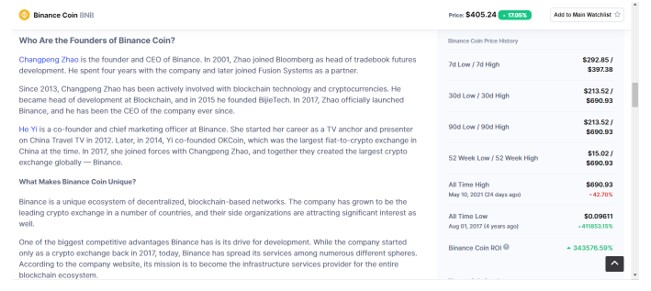
The Binance exchange is operated by Beijie Technology, a holding firm founded by ChangPeng Zhao in 2017. Zhao’s partnership with the Binance team, alongside the efforts from the company’s co-founder and CMO, He Yi, has made this exchange a force to reckon with in the cryptocurrency sphere.

BNB’s Selling Point

The Binance Coin, like other cryptocurrencies in development, has a variety of applications outside of the Binance exchange, including credit card payments, trading, booking travel arrangements, payment processing, discounted transactions on the exchange, loans and transfers, investment, and entertainment.

Alternatives to Binance Coin

Binance coin isn’t the only coin out there that takes it home in terms of trading fees, trading volume, compliance, regulations, and asset availability. Other ideal alternatives to this crypto include Coinbase, Uphold, HitBTC, Poloniex, NiceHash, and Kucoin.

BNB Statistics

BNB has a market cap of over $60 billion and a total available coin supply of 153.43 million BNB. It ranks 5th on the cryptocurrency market. The crypto as the default currency of the Binance ecosystem, entitles holders to airdrops of new projects that launches on the Binance Smart Chain.

Another notable factor is BNB’s ROI of 343576.59%. As of the time of this report, the cryptocurrency is worth $405.

IOTA (MIOTA)

Unlike other cryptocurrencies, IOTA doesn’t function as a blockchain. Rather, it is a distributed ledger that runs on Tangle – Its proprietary backbone system.

It comprises nodes implemented towards confirmation transactions on the network. Hence, Iota has faster transaction speeds, compared to the traditional blockchains. This feature and many more places the crypto at the forefront of digital currencies in the IoT ecosystem.

IOTA Team

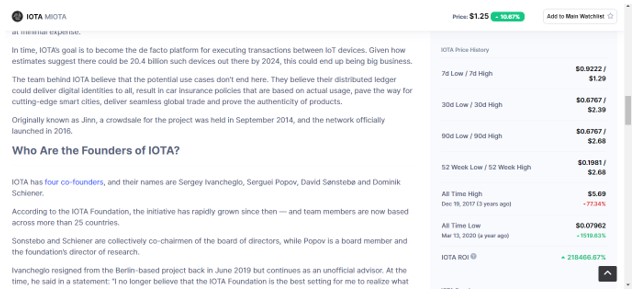
Iota is co-founded by four individuals, namely David Sønstebø, Serguei Popov, Dominik Schiener, and Sergey Ivancheglo. Serguei Popov, IOTA’s Foundation’s director of research is also a board member of the company, while Schiener and Sønstebø are co-chairmen of the board of directors.

IOTA’s Selling Point

The IOTA network provides secured transaction, but with a difference. It gets rid of the implementation of blocks.

According to David Sønstebø, “IOTA is designed to provide one solution that no other crypto does: efficient, secure, lightweight, real-time micro-transactions without fees.”

IOTA’s Alternative

The following cryptocurrencies are ideal replacements for IOTA, when factoring in instant transactions, real-time transfers, currency agnostic, transparency, fast P2P transactions, and Coinbase trading: Nano, Ripple, ZCash, and Stellar.

IOTA Statistics

IOTA has a total coin supply of more than 2.7 billion MIOTA. Its ROI sits at 218466.67%. In 2019, Bitrue users witnessed 7,000 IOTA airdrop shared on the network. At the moment, there is no news on the next airdrop. Currently, the cryptocurrency is worth $1.25.

Ethereum

Ethereum is an open-source, decentralised finance (DeFi) blockchain technology. Its coin, Ether (Eth), is used to conduct secured transactions on the network.

Ethereum serves as a platform for a variety of cryptocurrencies. This ecosystem also allows for decentralised smart contract execution.

Ethereum Team

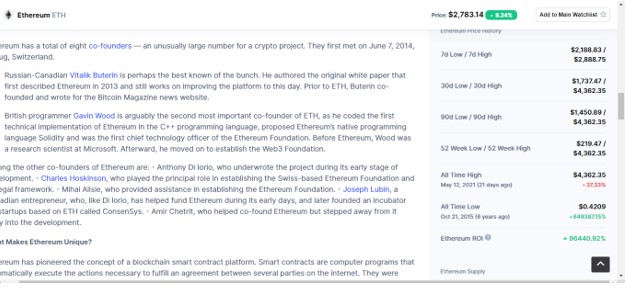
Ethereum was co-founded on July 30, 2015, by eight individuals, namely Gavin Wood, Vitalik Buterin, both of whom were ETH original authors, Charles Hoskinson, Anthony Di Lorio, Joseph Lubin, Mihai Alisie, Amir Chetrit, and Jeffrey Wilcke.

Ethereum’s Selling Point

According to Gavin Wood, the Eth blockchain serves as “one computer for the entire planet.” This implies that the blockchain creates a robust, censorship-resistant ecosystem for holders and investors.

Ethereum’s Alternative

The following platforms provide ideal alternatives to Ethereum: IBM Blockchain, Azure blockchain workbench, Kaleido blockchain, Amazon Quantum Ledger Database (AQLD), and Hyperledger.

ETH Statistics

There is a total of 116,125,822 ETH coin in supply, and at the moment, the crypto is worth $2,766.70. It also has an ROI of 96440.92%.

Stratis (Strax)

The Stratis network comes fully packed with several features that make transactions quicker and more secure. They include a proof-of-identity model, private sidechains, smart contract deployment, and full node operation.

The blockchain is powered by STRAX, used for payment and smart contract execution.

Users can create crypto wallets on the exchange and access consulting services via the Masternode.

Stratis Team

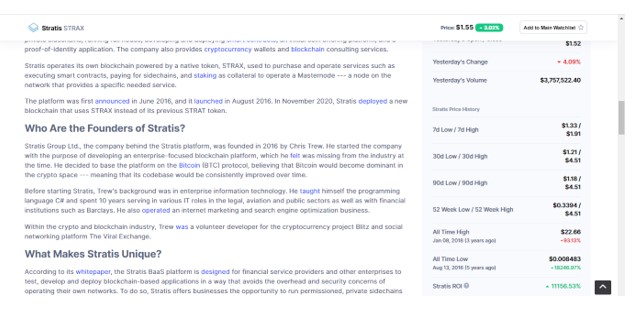
Strax’s existence is attributed to Chris Trew, the brain and founder of the enterprise-based blockchain. A C# programmer and IT expert, Trew created the Stratis BaaS platform based on the Bitcoin (BTC) protocol.

Stratis Selling Point

Financial service companies and other organisations can use the Stratis platform to test, develop and deploy DApps without having to worry about network security and operating expenses.

Stratis does so by allowing enterprises to create permission-granted, private sidechains that interface with the main chain, as well as host decentralised apps, execute smart contracts, and use other privacy and identity verification features.

According to its whitepaper, this technique allows businesses to utterly personalise their platforms without the constraints of depending on a big blockchain like ETH or BTC.

Stratis Alternative

Ideal alternatives to STRAX include Tron (TRX), EOS, Bitcoin Cash (BCH), and Litecoin (LTC).

Stratis Statistics

The Stratis BaaS platform has a total of 131,860,808 STRAX and an ROI of 11156.53%. Each coin is currently worth $1.55. So far, there are a total of 100,000 STRAX available to airdrop users.

Bitcoin (BTC)

This list will be incomplete without discussing Bitcoin – the pioneer of cryptocurrencies. This DeFi exchange provides P2P transactions devoid of intermediaries.

It implies that users on the network can send and receive BTC securely. Based on the founder’s views, the exchange creates a platform where “online payments can be sent directly from one party to another without going through a financial institution.”

The BTC coin may be used to acquire physical assets, and crypto traders may trade on the exchange as well.

Recommended: With Companies Investing In Bitcoin, Here Are The Likely Areas of Impact You Need To Know

Bitcoin’s Team

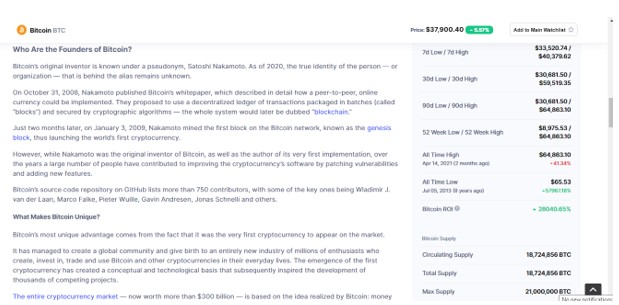
The real identity of Bitcoin’s founder still remains a mystery to date. Although to the general knowledge, the founder goes by the name Satoshi Nakamoto, there is a divided school of thought that this name might belong to an individual or a group of people using it as an alias.

Even though it was founded in January 2009 by Satoshi, several groups of developers have contributed to making the exchange a robust and secured crypto ecosystem for holders, investors, and traders.

Bitcoin’s Selling Point

The fact that Bitcoin was the first cryptocurrency to exist on the market gives it a distinct edge. At the moment, the cryptocurrency market is worth over $300 billion, thanks to the emergence of BTC.

The creation of the first cryptocurrency provided a conceptual and technological foundation for hundreds more competing ideas to follow.

It has also succeeded in establishing a worldwide community and spawning a completely new economy of millions of users who produce, invest in, trade, and utilise Bitcoin and other cryptocurrencies consistently.

Bitcoin’s Alternative

Crypto users who want to invest in other cryptocurrencies, other than Bitcoin, can purchase the following coins: Ethereum, Litecoin, Ripple, Dogecoin, Lisk, MaidSafeCoin, and Dash.

Bitcoin Statistics

Bitcoin has a maximum supply of 21 million BTC and a total supply of 18,724,856 BTC. Currently, one BTC is worth $37,929.96. Investors can purchase a handful of BTC coins as the crypto has an ROI of 28040.65%.

In Conclusion

Cryptocurrency is an excellent long-term investment alternative. It is important to note, however, that trading is not without risks.

Other than that, you may make financial transactions on the marketplaces discussed in this guide and grow your portfolio.