The performance of Dogecoin (DOGE) and dYdX (DYDX) in recent weeks has been mixed amid steady, but low-price gains. On the brighter side, the prospect court win by Ripple XRP was a big plus that somewhat brought a ray of sunshine to the crypto market scene.
For once, enthusiasts of digital currencies saw an opportunity to bask in the sun. whether this win will endure will only emerge in the months ahead.
In the last two weeks, some cryptocurrencies have shown some promise, and we consider two of these market leaders below;
Will Dogecoin (DOGE) Top the $0.08 Mark?
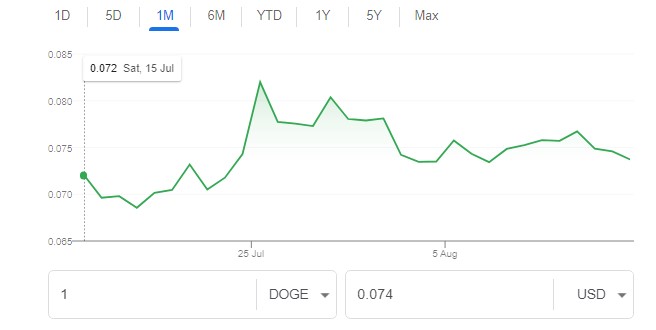
Dogecoin (DOGE) has gone past the $0.075 mark in the trading results of the last two days to peak at $0.077.The sideways movement in market price for Dogecoin (DOGE has been the norm in recent days for the meme coin. A whale sold off about $5 million worth of Dogecoin on 10th August 2023 and this could dampen the expectation of a price surge.
Apart from the mixed feelings that theDogecoin (DOGE) sellof conveyed, there was a bright spot on 6th August 2023, when it was reported that Dogecoin could be used as a processor for Twitter payments. Elon Musk has shown an abiding affinity for Dogecoin (DOGE). This hasn’t led to a price push as we head into a new week of trading.
Dogecoin (DOGE) has a supportive community and a price breakout at the $0.08 mark could open a new wave of demand that will benefit current Dogecoin (DOGE) holders. A price height of $0.10 for Dogecoin (DOGE) at the year-end is realizable if the stated headwinds materialize.
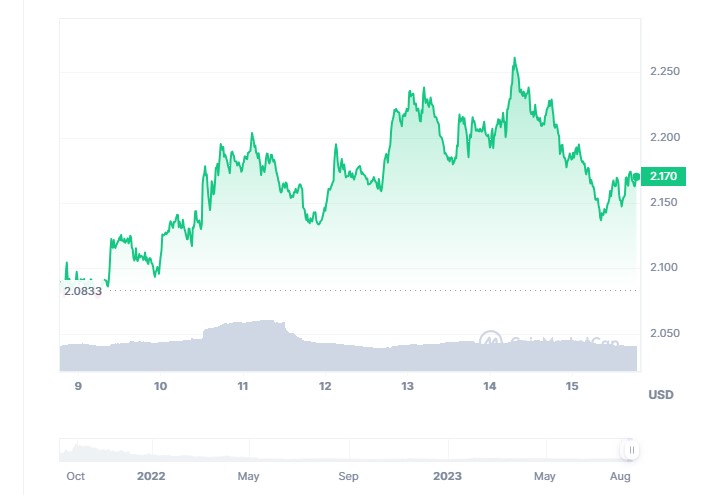
DYDX made the headlines when it rescheduled its Testnet launch for later in August 2023. The market price of DYDX has risen by 5.8% from $2.04 seven days ago to $2.20 in the last 24 hours with the new date appearing to be feasible.
When DYDX Testnet launch date was delayed on 3 August 2023, the token price plummeted to $1,92 from $2.02. The sentiments that a delay could mean something was wrong somewhere was evident with the price plunge. In the next couple of days, the market price of dYdX picked up again to hit the $2.08 mark as confidence in the token picked up again.
Ardent traders of DYDX are hoping that the expected launch will be successful so that its market price can appreciate. The promise of new features and markets for DYDX has given some crypto enthusiasts something to look out for in anticipating profit-taking.
Whether DYDX will cross the $2.10 mark after the testnet launch is a possibility that analysts expect in the coming weeks.
Looking Ahead
In the months to come, dYdX has the potential to make great progress stemming from its new testnet that could go full bloom as a blockchain. Dogecoin on the other hand, stands a chance to make progress as Twitter monetizes its platform, and Dogecoin will play a major role as a payment processor.
XRP recently recorded a favorable court ruling against the U.S. Securities and Exchange Commission (SEC). This decision was highly anticipated by many in the crypto community as it could have major implications for how digital assets are regulated in America going forward.
The issue at stake is whether XRP should be classified as a security under U.S law, which would require it to comply with federal securities regulations like other stocks and bonds do.
The SEC harped on the sales of billions of tokens to investors over several years by XRP to investors, thereby contravening the securities’ act. On its part Ripple maintained that since XRP has been used primarily for payments rather than investments then it should not be subject to SEC regulation as a security but instead treated more like currency or commodities such as gold and oil.
Ultimately Judge Sarah Netburn ruled in favor of Ripple stating that “there is no reason why [XRPs] economic reality must align with [the SECs] definition” thus allowing them some breathing room from strict regulatory oversight while still being able to operate legally within US borders.
While this ruling may seem small now, it could potentially set precedent for future cases involving cryptocurrencies across America if similar decisions are made down the line by other courts when faced with similar questions regarding asset classification.
Who is Judge Netburn?
Judge Sarah Netburn is a United States District Judge who was assigned to preside over the ongoing Securities and Exchange Commission (SEC) vs Ripple (XRP) case. Her role is to oversee the legal proceedings and make a final judgment based on the evidence presented by both parties.
SEC’s Case Against Ripple XRP
In the ongoing XRP case, the SEC (U.S. Securities and Exchange Commission) has accused Ripple, the company behind XRP, of conducting an unregistered securities offering worth $1.3 billion. The SEC alleges that Ripple’s sale of XRP tokens constitutes an investment contract and therefore should have been registered with the agency.
The SEC also claims that Ripple’s executives, including CEO Brad Garlinghouse and co-founder Chris Larsen, personally profited from the sale of XRP. Ripple has denied the allegations and argues that XRP is a currency rather than a security. The case is currently being heard in court, with Judge Sarah Netburn presiding over the proceedings.
How Ripple Defended its Stance
Ripple’s defense in the XRP case is that XRP is not a security but rather a currency or digital asset. Ripple argues that XRP is not an investment contract and therefore not subject to the same regulations as securities.
Ripple also claims that the SEC did not provide clear guidance on the status of XRP as a security for many years, leading to confusion in the market. Additionally, Ripple claims that the SEC’s actions have caused harm to XRP holders and the market. The trial Judge has ruled in favor of XRP and SEC has now moved on to appeal the case.
XRP price leapt by 80 percent in the wake of the recent court case against it by SEC. With the case outcome considered to be favorable by the market, the crypto looks set for a new high. Whether this will be sustained, is a different ballgame altogether.
Factors that can drive a rice rally includes the following:
Market Sentiment: Positive news, developments, partnerships, or regulatory clarity can significantly influence market sentiment, leading to increased demand for a cryptocurrency.
Adoption and Use Cases: Increased adoption and real-world use cases can boost the value of a cryptocurrency. If XRP gains traction as a preferred means of cross-border payments and other financial services, its price could rise.
Technological Developments: Advances in the technology behind a cryptocurrency can enhance its utility and security, attracting more investors and users.
Market Speculation: Speculative trading can lead to rapid price increases. Traders looking to profit from short-term price movements can create volatility in the market.
Macroeconomic Factors: Economic events, such as inflation concerns, currency devaluation, or geopolitical tensions, can drive investors toward cryptocurrencies as alternative assets.
Impact of Price Rallies
The effect of a price rally on the prospects of a cryptocurrency like XRP depends on various factors:
Positive Effects: A price rally can attract more attention, new investors, and increased adoption. It can also validate the utility of the cryptocurrency’s technology and use cases.
Negative Effects: Rapid price increases can also lead to concerns about market manipulation, excessive speculation, and a potential bubble. If the rally is not supported by fundamental improvements in technology and adoption, it could lead to a sharp price correction.
Regulatory Impact: Some price rallies might prompt regulatory scrutiny, especially if the rally appears disconnected from the actual utility of the cryptocurrency. Regulatory actions could impact the cryptocurrency’s prospects.
Long-Term Viability: For sustainable growth, a cryptocurrency’s price should ideally be supported by its real-world use cases, technological advancements, and a strong community. Price volatility without underlying substance could hinder long-term prospects.
TAKEWAYS
Keep in mind that the cryptocurrency market is highly speculative and can be influenced by a wide range of factors. To understand the specific factors leading the new XRP price rally and its potential implications, it’s best to refer to the most current and credible sources of information, as a series of events are still unfolding.
For quite some time now, Ripple, a blockchain-based payment protocol, has been seeking out means to improve the applications and adoption of XRP. Xpring, the investment arm and technology incubator of Ripple, announced its strategic investment in Flare Networks – a smart-contract-based platform.
The Ripple-Flare collaboration promises to add utility, value and new applications for XRP and its connected components.Let’s delve deeper into how the integration of smart contracts will activate Ripple’s market sprint.
The flare network connection
What is the Flare Network?
Flare is an avant-garde blockchain network that feeds off a similar consensus as Stellar and Ripple – the Federated Byzantine Agreement (FBA) protocol. This consensus protocol adopted by the Flare Network has flexible trust and completely ordered, making the possibility of an attack on the order of transactions almost inexistent.
Some of the features of the Flare Network include:
It is completely permissionless, open and Turing-complete.
The overall safety of the network is not dependent on economic incentives.
Owning a token on the network does not grant power
An algorithmic stablecoin that’s generated by burning Ripple (XRP) in parts
Flare adopts XRP’s address schemes and encryption protocols so that both networks can utilize a single key while providing XRP users with a seamless experience
Flare is a useful tool for entrepreneurs and businesses because of the price stability of its token and low volatility. Regardless of the size of your business, even when it grows large, the safety of the Flare Network remains uncompromised. Importantly, this network provides easy and alternative ways for XRP users to explore interesting and complex things.
Late 2019, Flare Network reported its investment and partnership deal with Xpring. A moved poised at bringing partners and an avalanche of resources to expand and enhance the XRP, Xpring and Flare ecosystems. The process entails the integration of the ETH Virtual Machine to allow private and public networks to take maximum advantage of Turing-complete smart contract.
According to the Xpring team, Flare will leverage on Ripple’s encryption system and address to offer Ripple users seamless interfacing with smart contracts. This mechanism is targeted at ensuring that ripple users can explore a variety of use cases for the XPR ledger, such as the development of apps and settlement of contracts
At the launch of the network, a protocol built on Flare, FXRP, will safely activate the trustless distribution, redemption and usage of Ripple (XRP) on Flare. XRP will be trustlessly and safely converted to FXRP and secured by Spark, Flare’s token. Flare will facilitate the interoperability of XRP and other networks through protocols such as Polkadot and Cosmos or with ETH via a structured bridge protocol.
What does this even mean? Basically, Flare can be utilized as a trustless and defined bridge between XRP and other networks, and more significantly, it can serve as XRP’s smart contract platform.
Furthermore, the Flare Protocol (FXRP) methodology could also be adopted by other non-flare tokens, as the means to determine suitable tokens is embedded into the system and its governance network.
Mechanism of the Flare Network and Ripple
FXRP grants holders of XRP (originators) the ability to transfer their asset to certain XRP Ledger (XPRL) addresses dubbed “agents.” In turn, originators get FXRP on a 1:1 conversion basis with XRP, of course, secured with Flare’s Spark. It is also possible for an FXRP holder (redeemers in this case) to redeem the equivalent worth of FXRP back in XRP.
All they need do is, transfer the FXRP back to Flare, and the agents will send the equivalent amount of XRP to the XPRL address of the redeemer; all facilitated by smart contracts. If for one reason or the other, the agent is unable to quickly see the redemption process through, the redeemer receives the equivalent value of FXRP in XRP and also compensation to cover transaction cost on the next XRP trade. Let’s take a typical illustration of the Flare-Ripple workflow.
“Say, Jake, for instance, wants to convert his XRP to FXRP on Flare; Jake is the originator. As already established, he’ll incur a transaction fee that’s a certain percentage of XRP. Jake specifies the volume to be converted and the FXRP system suggests the available agent (say Peter) on Flare and records the originator’s address on the XPRL.
If there exists an adequate volume of FXRP in the system, an escrow-like protocol locks the required volume of FXRP for some time, pending the authentication of Jake’s transaction. This means that James doesn’t have to contact Peter or even trust him.
Consequently, Peter’s address is generated by a set of algorithmic instructions and forwarded to Jake to fulfil his part of the transaction by transferring XRP to the XRPL, inclusive of transaction fees. The Flare system then mints FXRP and sends to Jake through his nominated address. If by any chance, the system does not have the desired volume FXRP, Jake is refunded his escrowed asset.”
The innovation in the mix
Ripple is in a league of its own for many reasons. It’s very unlike several other blockchain projects that just want to live up to BTC’s standards, without any particular use case or aim. Since its blowout in 2012, has always had the goal of using blockchain, XRP and the internet for cheap, cheap and reliable cross-border transfer of value.
In other words, Ripple hopes for banks and financial institutions to adopt its tech, but it’s been quite the opposite. Mainstream adoption has been a long-standing issue and Ripple resolved to delve into other use cases that will ignite the interest of the world. This concern is a contributing factor to the innovative collaboration with the Flare Network.
The ideology of the Flare-XRP collaboration was birthed to increase the use cases of the XPR token, promote platform interoperability and the utilization of XPRL. while also receiving massive representation in decentralized finance. It was only reasonable to have looked on to Flare Network, a new smart contracts platform for integration, although some enthusiasts disagree with Ripple’s move.
Conclusion
When you take a look at platforms that utilize the Proof-of-Work and Proof-of-Stake protocols, the security of such networks is mostly dictated by incentive given to nodes. In this case, Flare boasts an innovative security architecture that doesn’t survive on economic incentives. Also, the Flare-XRP collaboration has largely improved Ripple’s market performance and created avenues for more use cases.



 Harrison Global Capital